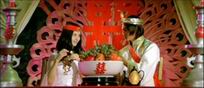
Long ago in ancient China, three beautiful sisters named Hei Qin (Lin Chen-chi), Hei Xiao (Fanny Fan Lei), and Hei Xian (Got Dik Wa) perform a sensual rain dance, hoping to break the drought that plagues their tribal village. This turns into a full-blown, mid-seventies musical number, complete with wah-wah guitar and disco flute as the girls jive about in bandanas, skimpy green halter tops and miniskirts. Drawn by this groovy spectacle, the magical Snake Prince (kung fu icon Ti Lung) adopts handsome human form alongside sidekick General Huang (Wang Yu) and um, another guy (Ng Hong Sang), and is swiftly smitten with Hei Qin. Disguised as a peddler, he visits the village and discovers Hei Qin’s kind heart and good sense match her beauty.
Meanwhile, the locals plot to divert the river and irrigate their village, even though this will damage the sacred forest on Snake Mountain. Flying snakes carry Mr. Hei (Cheng Miu) to a mystic lair where Snake Prince agrees to realign the river himself if the old man promises Hei Qin’s hand in marriage. Although the self-serving villagers try to cheat the prince, Hei Qin agrees to marry the monster and save her people. She settles into a blissfully happy life, singing and dancing amidst Snake Prince’s lavish, fairytale palace. However, trouble starts when Hei Qin invites her family to visit. Greedy Xiao isn’t satisfied with her sister’s gifts and tries to steal the royal jewels, while nasty Xian plots to kill Hei Qin and seduce the prince, which unleashes insanity, death and destruction.
If you don’t enjoy a) musicals, b) the seventies or c) weird Chinese cinema, then you’re clear out of luck with this one. More adventurous film fans will relish this loopy Shaw Brothers production. Celebrated director Lo Chen was known for heart-wrenching dramas like The Shepherd Girl (1963) or My Son (1969), but branched out in the seventies into musicals, martial arts fantasies and sexploitation. Here he seems to be doing all three, which results in an odd, but not unappealing genre hybrid.
One minute it’s a rock musical with a chorus line of scantily-clad dancers shimmying like the cast of Hair (1979), the next Ti Lung is kicking ass with (what else?) snake style kung fu, or unleashing gory monster madness (including real, live snakes flung at shrieking extras). Sultry sexploitation starlets Fanny Fan Lei and Got Dik Wa perform topless solo numbers (“I move my slender waist… lightly bite your lips… let’s make love!”), the fairytale ambience (gorgeous lighting, evocative sets, whimsical special effects) and innocent lovers are straight out of a Walt Disney cartoon, and there is a moment of twisted malevolence wherein Hei Xian stomps their newborn snake-babies to death. You never know what is going to happen next.
At heart it’s an engaging love story, featuring a pair of likeable leads and a message about love and tolerance. The Snake Prince fights when cornered, but clings to his ideal of non-violent co-existence with mankind, while Hei Qin proves a noble, sweet-natured heroine. Perhaps too sweet, given that every other human character is utterly despicable. Adorable Lin Chen-chi played another snake loving girl in Battle Wizard (1977). Here, in a kinky touch, the Snake Prince can only make love in his serpent guise, so we get to see a big, rubber snake wrapped around Chen-chi’s naked body. At her peak, the actress made three movies at Shaw Brothers each year, but her most celebrated performance was as the terrifying anti-heroine of Tsui Hark’s Dangerous Encounters of the First Kind (1980). Today, she runs a chain of steakhouse restaurants in Hong Kong.
John Woo fans will know Ti Lung from his twin handgun twirling roles in the A Better Tomorrow movies. Here is your chance to see him cutting a rug like a kung fu Gene Kelly, and of course turning into a big rubber snake. The giant snakes are blatantly fake, but pretty good puppets, especially when spewing-flames and splattering blood amidst the rousing climax. The funky rock meets Chinese opera soundtrack (which includes a disco version of the wedding song from Hong Kong Nocturne (1966)) comes courtesy of Frankie Chan, the multi-talented actor (he played the villain in Prodigal Son (1981)), composer and film director.