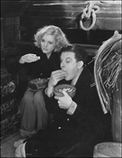
This frothy and fun comedy is routinely dismissed as one of Alfred Hitchcock’s few duds. However, as critic Noel Simsolo observes in his introduction to this DVD, the French consider it “a jewel of Hitchcock’s English era.” Since French critics were the first to recognise Hitchcock’s greatness, perhaps others should listen. Beginning like a PG Wodehouse story, Rich and Strange concerns Fred (Henry Kendall) and Emily Hill (Joan Barry), a young couple whose sudden inheritance from a wealthy uncle propels them on a voyage across the seas of China.
Both husband and wife find themselves tempted by suitors: Fred by an exotic princess (Betty Amann) and Emily by a suave colonel (Percy Marmont). Hitherto a slapstick comedy, the film suddenly becomes a rather touching portrait of a marriage in crisis. Like many, better known Hitchcock films, the sudden physical manifestation of unconscious desires begins to threaten a relationship.
Henry Kendall handles physical comedy well, but klutzy, fickle, would-be seducer Fred is often a self-pitying, dislikeable character. However, his moment of reconciliation with Emily amidst the rapidly sinking ship is a wonderful example of the Hitchcock touch: emotion delivered through action and humour. Hitchcock and his wife Alma Reville - an unsung collaborator on many of his greatest works - wrote the story, but claimed to have based it on a novel by the non-existent Dale Collins. A sly bit of Hitchcock humour, foreshadowing similar prankster auteurs like the Coen Brothers.
A few, inaudible passages of dialogue (mostly Betty Amann’s) are symptomatic of the era. However, at a time when most British cinema was staid and conventional, Hitchcock’s sprightly comedy is a wonder to behold: a running, stumbling, jumping, perpetual motion machine with moody lighting, animation, humorous title cards (a la Frasier), flashy editing and optical effects. Joan Berry is something of a wonder herself: cover girl gorgeous and delightfully daffy as Emily. Surprisingly, Hitchcock disliked Berry and resented having to settle for her as his leading lady. Nevertheless, his film’s most potent moments - such as Emily’s tearful abandonment of a fantasy life with her adoring colonel to save her feckless husband from shame - belong to the actress, a fine addition to the roster of Hitchcock blondes. Rich and Famous is a curate’s egg, best appreciated by Hitchcock devotees rather than casual viewers. A charming curiosity.
Hugely influential British director, renowned as "The Master of Suspense" for his way with thrillers. His first recognisably Hitchcockian film was The Lodger, but it was only until Blackmail (the first British sound film) that he found his calling. His other 1930s films included a few classics: Number Seventeen, The Man Who Knew Too Much, The 39 Steps, Secret Agent, Sabotage, The Lady Vanishes, Young and Innocent and Jamaica Inn.
Producer David O. Selznick gave Hitchcock his break in Hollywood directing Rebecca, and he never looked back. In the forties were Suspicion, thinly veiled propaganda Foreign Correspondent, the single set Lifeboat, Saboteur, Notorious, Spellbound (with the Salvador Dali dream sequence), Shadow of a Doubt (his personal favourite) and technician's nightmare Rope.
The sixties started strongly with groundbreaking horror Psycho, and The Birds was just as successful, but then Hitchcock went into decline with uninspired thrillers like Marnie, Torn Curtain and Topaz. The seventies saw a return to form with Frenzy, but his last film Family Plot was disappointing. Still, a great career, and his mixture of romance, black comedy, thrills and elaborate set pieces will always entertain. Watch out for his cameo appearances in most of his films.