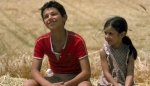
Southern Italy, 1978. It is the hottest summer of the century. Ten year-old Michele (Giuseppe Christiano), his little sister Maria (Giulia Matturo), and a group of friends are playing amidst the golden wheat fields near their small town of Acqua Traverse. Exploring a deserted farmhouse by himself, Michele discovers what he believes is a dead body, hidden inside a cavernous hole. He keeps this a secret from his overburdened mother (Aitana Sanchez-Gjon) and father (Dino Abbrescia) and returns to the site, only to find a small boy named Filippo (Mattia Di Pierro), not dead but frail, pallid and delirious. Michele visits him regularly, bringing food and water. Eventually he learns Filippo was kidnapped.
By now most viewers will be wondering when Michele is going to tell someone and bring Filippo some help. Which is when Gabriele Salvatores springs a gut-wrenching surprise that spins his film into a whole other dimension. The film’s source novel, written by Niccolo Ammaniti, was loosely based on a real kidnapping of a young boy from Milan. 1978 was the year kidnappings in Italy reached an all-time peak of nearly six hundred. It was not uncommon for kidnap victims, including children from wealthy families, to be transported down South where they would be hidden or even killed unless the ransom was paid. Indeed it was so great a problem that the Italian government elected to freeze the assets of any family whose children had been kidnapped in order to discourage the crime.
Salvatores interest lies less with the actual crime than in weaving a fable about one child’s loss of innocence. An early scene displays Michele’s moral fibre as he sticks up for his sister and a girl bullied into dropping her dress as a forfeit. He is an imaginative boy, prone to making up stories to bolster his courage. Along with the horror movie introduction we have to the kidnapped child - a pallid, pitiful, Gollum-like figure, driven mad by imprisonment - this shares certain parallels with Pan’s Labyrinth (2006), another tale of an imaginative child’s journey through the perils of adolescence. The film is shot with a dreamlike air and an eye for surreal detail amidst the seductive, summery cinematography. Salvatores is an eclectic filmmaker, with a cannon that stretches from Oscar-winning drama (Mediterraneo (1991)), to cyberpunk thriller (Nirvana (1997) with Christopher Lambert), and surreal horror (Denti (2000)), and drew some criticism for daring to paint with his camera instead of pursuing a traditional neo-realist style. More power to him, I say.
After beguiling us with his slow-burning storytelling, Salvatores rather rushes his climax. It quickens our excitement, but leaves the resolution somewhat abrupt, although open-ended in enough to leave us wanting to know more. He draws superb performances from his child actors and shows a real understanding for how kids behave in honest, unsentimental detail: as when a friend betrays Michele for the promise of a driving lesson. While several of the grownups are professional actors, the children are all locals citizens with no previous experience. Aitana Sanchez-Gjon, Dino Abrescia and Diego Abatantuono deliver skilful, nuanced performances, but the most profound and memorable moments belong to Mattia Di Piero, Giulia Matturo and especially Giuseppe Christiano.