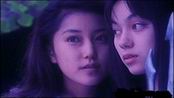
17 year old witch Misa Kuroi is back once more, played this time by Hinako Saeki. Many Japanese fans consider her the definitive Misa since she also appeared in the popular television series. Sort of like how everyone loves Sarah Michelle Geller’s Buffy the Vampire Slayer, while few remember Kirsty Swanson.
A temporal portal dumps a rotting zombie on a city street. “Misa Kuroi”, it croaks, before withering away. Close-up on a gory autopsy. Outside, two cops debate whether the legendary good witch is an urban myth, while Misa nonchalantly slips past to join her uncle, surgeon Satoru Kuroi (Bang-ho Cho). A flesh-eating larva springs out of the corpse - so Misa blasts it back to hell. Amidst the remains she finds a partially destroyed stage script. Misa’s suspicions lead her to the Saint Salem School for Girls, where she befriends shy new kid Aya Kinoshita (Ayaka Nanami) and joins the drama club led by pretty head-girl Hikaru (Yuki Hagiwara). Fellow students Yoko (Chika Fujimura), Mami (Hitomi Miwa), Kaori (Ayumi Takahashi), and Yuki (Yuko Takimura) are all troubled in particular ways, but form healing friendships whilst rehearsing their end of term production. To her horror, Misa discovers a sacrificial ceremony is being unwittingly performed in the guise of a harmless school play. An evil wizard plans to extract the souls of “seven sacrificial angels” in the cruellest, most painful way imaginable so that he may summon a race of flesh-eating monsters and conquer the world.
Despite the departure of original director Shimako Sato and star Kimika Yoshino, this is the most imaginative and compelling Eko Eko Azarak movie yet. After a slow start, with new director Katsuhito Ueno eulogising his cute schoolgirl protagonists in poetic slow-motion, the attention to character pays off once themes of friendship, love, self-sacrifice and humanity bubble to the surface. Ueno spends a long time getting to know these girls, who are a pleasingly believable lot. They smoke, squabble, bond and form semi-romantic attachments, yet most crucially reveal neuroses and suppressed traumas that the monster cruelly exploits. Once things turn spooky, the girls are haunted by buried memories and hidden desires made flesh as ghost kids and killer dolls. Most impressively disturbing is a girl driven to kill by memories of child abuse.
Hinako Saeki’s Misa is colder, more introverted; a demeanour calculated to keep friendship at bay and prevent innocent deaths. Nonetheless she warms to these girls and each death proves heartbreaking. Also worth a mention is Bang-ho Cho - very funny as Misa’s posturing surgeon uncle (“Ready for critical surgery! Let’s go!”). A popular character in the original manga, Satoru displays awkward, yet endearing concern for his wayward niece, something even the sight his hilarious novelty pyjamas cannot diminish.
Ueno favours blue filters, dreamy soft focus and cameras swooping even more wildly than Shimako Sato’s. Layered flashbacks and diffuse symbolism occasionally prove disorientating, but add up to an impressive sense of supernatural unease. The central conceit of a school play-cum-satanic ritual re-enacting past traumas is subtly ingenious and staged amidst prisms of rainbow coloured light that recall Suspiria (1977), while a girl assaulted by demonic flora evokes The Evil Dead (1983). Sam Raimi and Dario Argento have been touchstones throughout the Eko Eko Azarak series, yet its beating heart remains pure shojo manga. The dewy-eyed romance, aestheticized bloodletting, childhood terrors (killer toys, deadly flowers, raining slime, lumpy monsters), and the heroines’ pretty fairytale costumes are classic components of the “Disney gone mad” world of shojo horror. Its mix of beauty and nausea may seem alien to western eyes, but is closer in spirit to real Japanese horror than all those Ring (1998) clones currently clogging up video shelves.
The film evolves into a fever dream of eerie purple, blue and velvet hues, with blinding white (in Japan: the colour of death) reserved for the best bathtub scare since A Nightmare on Elm Street (1984). Ueno sticks to storybook strangeness, but holds back the gore until the all-action finale. Impressive scenes include Misa slicing her way through monster hordes and summoning a dead wizard to explain the plot, before a neat Frankenstein twist suggests both mystery villain and one would-be victim are really homunculi - artificial beings supposedly free from sin. Misa the Dark Angel gives the title heroine far more to do, but also a devious, gorgeous villain to pit wits against. The life-affirming coda is quite beautiful and moving.