The time of the Napoleonic wars, and one officer is not having a good time of it, being as he is in the thick of battle. As he tries and fails to rally his troops, with cannon fire and gunfire exploding around him, he takes refuge in a cottage nearby and rushes up to the top floor. There he finds a pitcher of wine which he slurps from, and a large book which he idly opens, but is soon engrossed, so much so that when rival troops arrive to arrest him, he silences them because he wants to look at the pictures in the book. The captain of the rivals can read Spanish and after flicking through it, finds an account of his own grandfather, the Belgian Alphonse Van Worden (Zbigniew Cybulski)...
As you may gather from seeing the size of that book, there are a whole lot of stories contained within, and after a while it seems as though director Wojciech Has is determined to include them all. Based on a well-thought-of but somewhat obscure text written by Jan Potocki sometime in the early nineteenth century, which tellingly was never entirely completed, this film, Rekopis znaleziony w Saragossie as it was originally known, quickly gathered a cult audience among the hipper sixties audiences who were more receptive to its mind-bending narrative.
Some of those fans included famed surrealist Luis Buñuel, who liked it enough to watch it three times, no small achievement for him apparently, and Grateful Dead leader Jerry Garcia, who went as far as securing an uncut Polish print for America (the film had been edited for distribution outside Poland). Other fans the film has accumulated over the years include such prestigious figures as directors Martin Scorsese and Francis Ford Coppola, writer Neil Gaiman and actor Harvey Keitel, all of whom have creative opinions worth respecting. So what are they seeing in this jumble of flashbacks and repetitions?
If you've only seen brooding leading man Cybulski in his Andrzej Wajda films, or only know him from his cult reputation as the Polish James Dean who died in mysterious circumstances, then you may not be prepared for his decidedly more jovial, light-hearted incarnation here, but you can still appreciate the charisma that glows from the screen whenever he appears. All this without his trademark dark glasses, too. It is he who helps guide the audience through the incredibly over-involved plotting as Alphonse finds himself trapped in a spiral of events that echo and relate to each other in ways that he only latches on to once they have occurred.
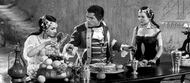
His first adventure sees him wind up near a gallows, complete with hanging corpses, after being separated from his men. He wanders into a nearby inn where he finds something to drink, just what he needs but frustrating desires is what this film is all about and he is interrupted by what looks like a nun with a torn habit, baring one of her breasts, who leads Alphonse down to a secret chamber which contains two incestuous sisters who claim to be his cousins. In addition, they promise him a life of pleasure if he gets them pregnant, but first he has convert to Islam. Not that he reaches that point, because no sooner has he drunk from a skull-adorned chalice, he is unconscious and lying back out by the gallows again - this will become a familiar sight. For the first part, this is fascinating stuff, but three hours is a lot to ask for a story going round in circles and with Cybulski absent for much of the second part it's easy to grow restless with its repeated tales of thwarted passions. There's no denying it's worth seeing, however: you'll know if this is your cup of tea. Music by Krzysztof Penderecki.




 Display comments