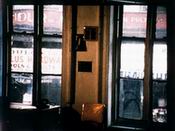
In a large, unfurnished loft room with three windows, a woman guides two people carrying a bookcase to one wall, then they all leave. We are left to stare at the empty room as we catch glimpses of vehicles passing by outside and notice the camera is zooming in onto one fixed point. Just as it looks as if nothing will happen, a couple of women enter and walk up to the windows, then turn a radio on and listen to the Beatles perform "Strawberry Fields Forever". When they leave soon after, we're back to watching the empty room.
And so it goes on, only after the Beatles have stopped a new sound is heard, that of a sine wave recording, which rises in pitch for the rest of the thirty-five minutes or so that the film has to go, and it's only just over forty minutes long. For some Wavelength feels far longer such is its lack of incident, but things do happen nevertheless, as director Michael Snow teases us that there will be some kind of story arising. As it is, everything occuring falls before that sense of inexorably and obsessively working towards a climax.
This was part of the structural film movement, works that would go out of their way to have as little as possible happen, with lengthy takes and little variety in what you witness on the screen. Here, this means that it appears to be all one long take, but after a while you realise this is not the case and the room varies between day and night, proving that it was shot over a longer period of time than it initially appears. As it draws on, a meditative quality makes itself clear, and the viewer can easily lose themselves in the snail's pacing and extreme focus.
On the other hand, Wavelength has become notorious in some quarters for being a cinematic endurance test, with the question of how long you can last without giving up paramount. Perhaps Snow's intention was to separate the film buff men from the film buff boys, and his purity of vision can be admired from some angles. With that tone piercing the eardrums, it could be he is punishing the audience rather than encouraging them, and the minimal incident at times seems like some kind of in-joke. At one point, after we have heard something smashing, a man walks into frame and as if the intensity of the camera's stare is too much for him he collapses, presumably dead: was that supposed to be funny? The film does end on a visual pun, which I won't spoil, but there will be no in between with this, either you won't get past the first five minutes or you'll set your mind to it and, captivated, reach the very end.