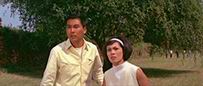
In the swinging sixties the world went crazy for spy movies. James Bond imitators sprung up all over the place: in the USA, Italy, Germany and France. Less well known are the numerous Hong Kong spy thrillers churned out by the venerable Shaw Brothers studio, of which The Golden Buddha is a fine example. Paul Chang Chung plays… er… Paul Chang Chung, a handsome and debonair jet-setter en route to Singapore when his briefcase is mixed up with that of an old friend. Stranded in Bangkok, he visits his friend only to find him with a knife in his chest.
Pretty soon Paul is being chased by assassins and thugs, demanding he reveal the secrets of a golden statuette hidden in the briefcase. It turns out there a several golden Buddhas hidden around that reveal the whereabouts of a fabulous treasure sought by the evil Skeleton Gang. After a steamy liaison with a sultry femme fatale (Fanny Fan), Paul teams up with the treasure’s rightful heiress, Mei-Nan Chan (Jeanette Lin Tsui) and her tubby big brother (Lo Wei) to solve the riddle, foil the bad guys, and nab that loot.
While the first two thirds make for a just about believable thriller, akin to North By Northwest (1959) or From Russia with Love (1963), the latter stages enter sci-fi territory. So we get a futuristic lair, costumed supervillains and a death ray device that melts people’s faces. Despite sluggish direction from Lo Wei and fight choreography that is very poor by Hong Kong standards, this is a spirited spy caper with a stylish sense of fun that proves quite engaging. It was a steamy romantic drama that turned Lo Wei into Hong Kong’s first millionaire filmmaker, although he is best known for his Bruce Lee vehicles: The Big Boss (1971) and Fist of Fury (1972). He made films in a number of different genres at Shaw Bros., many of which suffer from pacing problems, although insiders claim Wei left the actual directing to assistants while he listened to horseracing reports. He also tended to cast himself as obnoxious authority figures, but his innate belligerence works quite effectively here.
Once Jeanette Lin Tsui arrives on the scene the film morphs into Charade (1963), with a number of well crafted, cute gags as our heroes are embarrassed at a massage parlour; hire a little girl to outsmart a dopey henchman; mistakenly beat up some cops; and, in a scene that resembles The Silencers (1966), play it cool at a swanky nightclub where a bikini clad bellydancer is shot by the villains. Typical for a sixties spy movie, Paul gets to bed the voluptuous bad girl and romance the lovely, virtuous Mei-Nan. Chang Chung makes a suave hero, while Jeanette Lin Tsui is a heroine in the Audrey Hepburn mould. Clever, resourceful (she’s the one who deciphers all the clues) and modelling some chic, sixties fashions.
Connoisseurs should relish the original theatrical trailer included on Celestial’s region 3 DVD (“Desperate struggle for treasure! Beautiful girls galore! Suspense in the Bond tradition!”) and the excellent lounge music score that features cues raided from Thunderball (1965), Where the Spies Are (1966), The Magnificent Seven (1961), and many others. Tung Shao Lung’s crisp cinematography really comes into its own once we reach the Skeleton Gang’s underwater layer. A pop art explosion of lethal traps, killing machines, black clad footsoldiers, gorgeous handmaidens and eye-popping designs are worthy of Ken Adam. The film’s best scene has the villain hauled away by cops - still wearing his gold lamé jumpsuit and crimson cape. He’ll be a popular boy in some sweaty Thai prison wearing that little outfit…