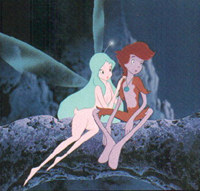
Long ago, spirits of fire and water lived as one. But jealous Algaroch, lord of the winds, drove a rift between King Oceanus and his sister Hyperia, queen of fire. Since then fire fairies and water sprites have been at war and forbidden from consorting, but when Prince Sirius, the king’s chosen successor, meets Hyperia’s beautiful daughter Malta, they fall madly in love. Their star-crossed romance upsets golden fairy Fiale, who harbours her own secret crush on Malta, while little sea urchin Bibble bemoans Sirius’ absence when the undersea kingdom suffers a jellyfish attack. After Malta neglects her royal duty to protect the Holy Flame, their secret comes out. Slimy sea serpent Mugwamp the Magnificent, who covets Sirius’ throne, seizes his chance and sets the young lovers fleeing their vengeful parents. A wise, old turtle explains their one chance is to reach the hill of Elysium during the next solar eclipse, where a magic flower blossoms that can carry them to a distant star where fire and water live as one.
From the late seventies to the mid-eighties, Sanrio (the company best known for its Hello Kitty merchandise) made a determined bid to become the next Walt Disney Studios. Beginning with The Mouse and His Child (1977), they produced a string of lavish animated features that, while successful in Japan and Asia, proved to be costly failures throughout the western world. After the disastrous international co-production, Little Nemo (1991), Sanrio shelved their ambitions and concentrated on toys, but screenings on cable TV won their movies a loyal fan following. None more deserving than Sea Prince and the Fire Child, which marks the pinnacle of their achievements.
At a time when Disney had almost given up making cartoons, this film boasts dazzlingly fluid animation, audacious multi-plane camerawork and evocative character designs. From the wondrous undersea kingdom haunted by floating anemones, swaying fronds, sea dragons and delightfully odd fish characters, to the pastel-hued fairyland of fluttering wisps, vast pools of stars, and flower palaces. A sense of grandeur pervades the production, which extends from soaring beauty of Koichi Sugiyama’s orchestral score (a rarity in anime) to the impressive designs of Hyperia, a towering fire maiden with a Bride of Frankenstein hairdo, and King Oceanus, a Godzilla-sized sea monster who slightly resembles the Forest God in Princess Mononoke (1997).
Co-written by Masami Hata and Chiho Katsura, this was one of several Sanrio projects based on a novel by Shintaro Tsuji. The story is a loose retelling of Romeo and Juliet, itself a version of many tales of star-crossed lovers from around the world, and succeeds in melding extravagant, Disneyesque visuals with a more sophisticated anime storyline. Twists and turns cast perilous obstacles in the lovers’ path and there are genuinely heartrending scenes of death, tragedy and self-sacrifice. A subplot about Mugwamp’s attempt to resurrect Algaroch remains undeveloped, but there are memorable turns from Fiale and Bibble (who offers Sirius the horn plucked from his head because “that’s all I have to give”), plus the sagely Aristurtle (a corny pun that raises a smile).
Most crucially, the young lovers are vibrant and richly characterized, wrestling with anxieties, duty and prejudice. Boyish, energetic Prince Sirius floats about with the swashbuckling verve of Disney’s Peter Pan (1953), while Malta proves a surprisingly sexy, capable heroine and is beautifully animated. Note the ripples as she skips along the water - a mark of the attention to detail that won Hata the chance to replace Hayao Miyazaki on Little Nemo. Like Juliet, Malta proves more emotionally mature and thoughtful and balances out her reckless Romeo. Their first encounter is a magical piece of animation, set amidst a trippy light-shower straight out of 2001: A Space Odyssey (1968) and again, surprisingly sexy as Sirius presses his head to Malta’s naked body “trying to hear her heart” (yeah, that old line). Hata pulls out all the visual and emotional stops for a kaleidoscopic, achingly poignant conclusion that stays true to the spirit of Romeo and Juliet without being too downbeat for kids.