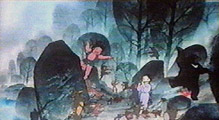
One of two anime films released in 1979 based on the same children’s book by Miyoko Matsutani (the other being Hiroshi Saito’s [FILM[Taro Maegami), Taro the Dragon Boy will strike a winning chord with anyone beguiled by Hayao Miyazaki’s Princess Mononoke (1997) or Spirited Away (2001). Taro is a greedy, lazy village boy who sleeps at home while his poor, suffering grandmother works all day. He is uncommonly strong though and teaches forest animals how to wrestle. Suitably impressed, a tengu (Japanese long-nosed goblin) gives Taro the strength of a hundred men, but warns it can only be used to help others. He puts it to use defending Aya, whose flute-playing charms the animals, but angers Red Oni (demon) and his master, Black Oni. After Taro’s heroism brings prosperity to the village, his grandmother reveals that his long-lost mother was turned into a dragon as punishment for her greediness. The dragon boy sets forth with a sense of purpose to find his mother and free her from the spell.
Writer-director Kirio Urayama worked mostly in live action, but decided animation was the right medium for this pet project. Taro the Dragon Boy is a socially conscious fairytale wherein the hero goes on his epic quest, not for fortune and glory, but something as simple as water and grain. Set at a time when myth merges with geological history, the overriding theme is one of community spirit, hard work and generosity gradually taming a hostile land. As with all good quests, it’s not the destination that is important, it’s the journey. Taro performs good deeds wherever he goes and moves people with his gentle heart. In one of the most memorable scenes, he carts off a huge, bushel of grain from a miserly old woman and feeds village after village. “I never dreamt I’d eat anything so fancy”, says one starving peasant, faced with a humble, yet nourishing ball of rice.
The animation isn’t as lavish as some Toei productions of the period, but remains eye-catching and consistently inventive. Painted backdrops mimic traditional Japanese watercolour scrolls, while Urayama and key animator Yoichi Otabe (who worked on the Isao Takahata/Hayao Miyazaki classic: Heidi (1974)) make interesting use of still photos, black and white sketches, and some truly inspiring sound effects. Youngsters will delight in an array of dancing raccoons, monkeys, rabbits and bears, plus fantastical creatures like the talking boar and magic pony - all beautifully drawn. The first sight of Taro’s dragon mom as she bursts out of the lake is a magical moment. Some may find the touches of sexuality a trifle unsettling, as when the creepy Mountain Witch makes a pass at young Taro or Snow Ghosts hug and kiss him till he is drained of life, but these elements are common to Asian folktales, even those aimed at kids. It’s gratifying that Aya doesn’t simper on the sidelines. She proves a plucky, little heroine and plays a key role in finding Taro’s mother. Even Red Oni proves his mettle during the knockabout battle with Black Oni, evoking another tradition found in folktales and classic anime like Dragonball (1986) - vanquished enemies becoming the hero’s friends. There isn’t much ‘special’ about Diskotek Media’s region 1 special edition, with extras limited to two trailers: this film and Animal Treasure Island (1971).