Here it is, folks. The greatest Japanese horror movie of all time! Forget all those Ring (1998) clones churned out since the late nineties, House taps the real spirit of Asian horror: eerie, sexy, surprisingly moving and funny, and overflowing with candy-coloured, psychedelic weirdness. Toho studios called on debuting director Nobuhiko Obayashi to churn out a simple “youth movie”, little suspecting he had a hidden agenda. Obayashi imagined something that would revive the industry and inspire a new generation to love Japanese film. He tackled House like it was Gone With The Wind, armed with a hundred in-joke references to J-cinema, and spectacularly surreal horror set-pieces… conceived by his six year old daughter.
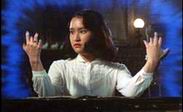
Beautiful teenager, Oshare (Kimiko Ikegami) has been happy living alone with her widowed father, indulging storybook fantasies about her late mother. Dreamy soft-focus, caressing sunshine and fan-blown hair idealize Oshare as though she were the loveliest angel on god’s green earth. She inhabits an idyllic wonderland straight out of shojo manga or a Saturday morning kid’s cartoon, with painted backdrops, soaring rainbows and a glorious, artificial sun. Oshare is heartbroken when daddy brings home his new, young bride (Haruko Wanibuchi). Sinister, serene and brazenly sensual - all scarlet lipstick and flowing scarves - she’s an adolescent’s vision of a wicked stepmother. In despair, Oshare reaches out to her maiden aunt (Yoko Minamida), whom she hasn’t seen in many years, and receives an invitation to visit their ancestral home.
Oshare gathers a tight-knit group of gal pals, each of whom have character-coded names a la Snow White and the Seven Dwarfs. Melody (Eriko Tanaka) plays piano, Fantasy (Kumiko Ohba) is a daydreaming romantic, Mack overeats (as in “stomach” - get it?), while Kung Fu (Miki Jinbo) knows kung fu and has her own wah-wah guitar-driven, action theme. The girls trek across rolling hills to the remote, country mansion where Oshare’s grey-haired aunt, dubbed “Granny” by the other girls, beguiles them with the tale of her lost love. Flashbacks play out like a silent movie while the girls gasp and comment like an audience at a matinee review. Granny’s fiancee gallops along on his white horse, in Prussian soldier garb, looking like a Jane Austen hero by way of chocolate box artwork. He died in the war (ah, but which war?) aeons ago, but Granny remains in her family home, waiting for him to return.
Something is very, very wrong with this house. The girls discover Granny died years ago and has become a ghostly witch alongside her creepy cat, Snowflake that exerts its own mysterious spell. The house is alive, infected with a vengeful spirit that literally gobbles up virgin girls to sustain itself. Melody is messily devoured and digested by a grand piano. Another girl becomes part of the cogs and gears of a transparent clock. Someone dances with a cartoon skeleton. Fantasy emerges as a smiling giant from a television screen. Vampires lunge out of mirrors. A portrait of Snowball vomits torrents of blood. A giggling, severed head bounces from scene to scene. The house warps and grows into a anime monster. Indeed, the whole movie becomes a cartoon, startling our live-action heroines, and things just get crazier. Oshare learns she can survive the night only by having a sexual experience. Weird toys and strange décor possessed by the spirits of her friends compel her to masturbate. She is haunted by fevered dreams of her first orgasm.
Gallons upon gallons of blood drench the screen, yet the effect isn’t nausea but joy. Obayashi turns this bizarre haunted house fable into a cockeyed celebration of life, a fairytale of sexual awakening. His stated intention was to present reality through fantasy: “To go beyond the body to find out what is in the heart.” It’s a philosophy Obayashi carried throughout his career as Japan’s foremost auteur of the fantastique, in classics like Target: Campus (1981), The Girl Who Conquered Time (1983), Summer with Ghosts (1989) and the anime Kenya Boy (1984). Following a failed bid for international success with Drifting Classroom (1981), an adaptation of Kazuo Umezu’s horror manga (considered Japan’s greatest work of horror art) starring ageing heartthrob Troy Donahue (?!), Obayashi abandoned the genre for more conventional filmmaking. In terms of sheer audacity he never topped his debut.
Imagination erupts from literally every frame. Stop-motion, fisheye lens, surreal matte paintings, cell animation, strobe edits, and a unique amalgamation of then-contemporary optical tricks and do-it-yourself special effects culled from community theatre and children’s television. Not a second passes without including a trick shot that, instead of merely showing off, is meant to provoke an impassioned response. Like Star Wars (1977) or Zu: Warriors from the Magic Mountain (1983), House was meant to re-energize audiences and engage them with cinema. It packs a potent subtext too, evoking adolescent anxieties about sex, family and growing up, given weight by a tour-de-force from acclaimed actress Kimiko Ikegami. She gives one of the finest performances ever in a horror movie, wrapped up in a bubblegum pop soundtrack from Godiego, the group who sang the theme to Monkey (1979)!
For many reviewers, House seems to conjure a world without precedent, but it’s one very familiar to readers of shojo horror manga. In Japan, horror is a genre targeted primarily at young girls and shojo manga provides an unlikely, but common fusion between the heartfelt wonder and innocence of Walt Disney and the aestheticized terror of Dario Argento. It’s a world that Obayashi’s daughter must surely have been acquainted with, for House is remains the only live-action movie ever able to capture its unique essence. A masterpiece and adventurous horror fans should check it out.
[House is available on a special edition Blu-ray from Eureka's Masters of Cinema. Here's what you can expect:
Stunning 1080p presentation from a high-definition digital transfer
Original monaural soundtrack presented as uncompressed LPCM audio
Optional English subtitles | An exclusive video essay by critic and filmmaker David Cairns
90-minute archive of interviews with director Nobuhiko Obayashi, scenarist Chigumi Obayashi, actress Kumiko Oba, and Toho promotional executive Shoho Tomiyama
Original Japanese theatrical trailer
A collector's booklet featuring an essay by Paul Roquet; poster gallery; and archival imagery.]




 Display comments