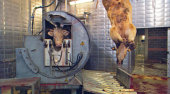
We see two lines of pig carcasses hung up while a worker washes the floor beneath them with a high pressure hose. There follows a selection of images from food production across Europe, both the animals that provide the meat, milk and eggs and the plants that provide the fruit, vegetables and grain, from a vast greenhouse in which countless tomatoes are grown to a herd of cows squeezed into space where they are milked, and so forth. All the industrial elements that take life and transform it into something for us to eat are depicted here.
And it is up your own conscience whether what you see is palatable to you. Although the subject is presented dispassionately in Nikolaus Geyrhalter's documentary, the unspoken question is how you can live with yourself after witnessing the manner in which your food is produced. Now, he and his co-scripter and editor Wolfgang Widerhofer had the full co-operation of the companies involved, so they were obviously quite happy for the cameras to film on their properties, and the conditions are professional and not unhygenic as far as we can make out.
Not only that, but there would be few people who would object to the production lines designed to harvest the fruit and veg; perhaps the extensive use of pesticides might rankle with some, but otherwise not even vegetarians would protest. No, what the real controversy is over is the treatment of animals. Whether they are cows being milked or bulls and pigs being slaughtered, it's the hardest of hearts that would not feel even a pang of regret when you see the beasts panic as they realise they are about to be killed.
Early on, Geyrhalter and Widerhofer place one of the most emotive sequences right up front, as thousands of little yellow chicks are placed on a conveyer belt to sort out which are dead, then the living ones have their beaks snipped after a journey down what in other circumstances could have been the baby chicken equivalent of a thrill ride as they are shot out of tubes and dropped into trays. Where previous documentaries such as The Animals Film have opted for the pointing finger of accusation, here you're left to make up your own mind if you can stomach your next roast dinner.
The workers are not immune to the camera's gaze, either, as they are filmed not only going about their business but also eating during their breaks. Eating the food they and their comrades have assisted in creating, meaning they have been inexorably drawn into the system as well, it all seems to say. They might be working in a salt mine, or shooting bolts into the heads of cattle, but there's no escape - although whether they have the feeling they're trapped in soul-destroying labour or if it's just another job to them is never made clear. With no narration, music or subtitles for the dialogue we do hear if you don't speak the language, we only have the imagery to guide us with its curious contraptions to separate farm animals and fish from their guts, or keep the production line of creatures and plants born and dying going with the minimum of fuss. If there's one thing missing from the process, it has to be kindness.