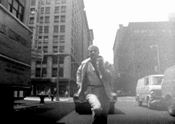
Max Menace (Eric Mitchell) is a terrorist from Europe on a mission in New York City. He arrives at the airport in the middle of the night, and while walking away he notices a taxi drive up and the cabbie shout to him if he wants a ride. He does, and gets in and orders him to drive to Manhattan, but when the cabbie asks him about what he has planned here Max makes it clear he is in no mood for talking. He has to find out who his contact is, but this is easier said than done as it becomes apparent that whatever Max's mission may be, there's nobody around who is willing to help him out... quite the opposite in most cases.
If you ever wondered what Jean-Luc Godard's Alphaville would look like if it had taken New York City as its location and Andy Warhol was on script duties, then look no further than this punk-inspired underground movie made by auteur Amos Poe. Alas, if those two giants of art film had been involved, the results might have been more stimulating than what Poe offered up here. Now chiefly of interest to those who are experts in the New York punk scene circa 1977 and might recall some of the more obscure faces, it's interesting historically, but dramatically somewhat inert.
Not that it lacks incident, it's simply that the whole thing falls back on existentialism for its plot, which essentially means a lot of wandering about leaving the viewer to make up their mind as to the point of it all. On the plus side, the grainy black and white footage of the city streets and landmarks are pleasingly evocative of their time, and the "so what?" attitude of the punks breaks through the general torpor in a few vivid scenes. Max is passed from contact to contact, meeting them at locations such as the World Trade Center which chillingly rises into the sky in the background, but whether its unsettling because of what happened to it decades later or if it's Poe's style is open to question.
Max doesn't have much luck, all told, as after it is established that nobody seems to know why he is there or who he is searching for, he frequently gets assaulted or otherwise suffers indginities from the shady characters he encounters. On his trail is what appears to be a female private detective called Harlow (Patti Astor) who spends all her time archly walking about in heels and a revealing dress, and she's not the only one who is after him. For the last twenty minutes or so, Max is chased around town, running away from a car that pursues him at great length. This is what passes for an action sequence, and while it manages to be visually striking, when you're not aware of the reason it's happening it can test the patience.
Obviously low budget, that lack of coherence can be put down to technical difficulties for a lot of the time. The scratchy and grainy film stock adds a lot of atmosphere, but the muffled sound recording leaves too much of the dialogue an impenetrable drone. All this goes to prove that while lo-fi filmmaking might have its own particular glamour, it can also begin to resemble someone's home movies if the director is not careful. However, not everyone's home movies feature Deborah Harry, who appears here in what amounts to a cameo role - but at least Poe got her to sing. On the musical side, The Cramps appear in violent mode, as do the less famous Erasers, and for some the scenes in CBGB's will be reason enough to watch this. As I say, The Foreigner is extremely redolent of its day, but most people might not find that to be enough. Music by Ivan Kral.