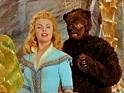
The handsome Prince (Eckart Dux) travelled for many miles across the land to reach the palace where he knew a beautiful Princess (Christel Bodenstein) was awaiting a suitor to ask for her hand in marrriage. When the Prince arrived at the gates he was reverently escorted inside, and presented to the King (Charles Hans Vogt). He had a gift for the Princess and handed it over, but to his shock she when she opened the precious box and saw the pearls inside, she merely turned up her nose and let them spill out over the floor. For the Princess was the most arrogant and spoiled in the world, and nothing less than the Singing Ringing Tree of legend would satisfy her...
If you were a child in Europe around about the time this was made until around 1980, then chances are that scenes from The Singing Ringing Tree, or Das Singende, klingende Bäumchen as it was originally known, will be seared into your memory. It was one of many fairy tale films produced by the East German production studio DEFA, and with its eye-wateringly bright colours and genuinely bizarre flights of fancy it's not a surprise that there are plenty of people who look back on it with a mixture of fondness and disquiet, as above all it was oddly disturbing.
It certainly looks like a fairy tale, all created on meticulously designed sets, and like those stories it features a powerful moral about doing good: essentially treat others well and with respect and you will be rewarded, because if you don't, nightmares await. It may have a twinkly gloss, but the film also has a steely, uncompromising feel about it, as the Princess suffers greatly for acting so abominably towards not only the people she meets but the animals she encounters as well. Her order to the Prince to fetch her the Tree of the title (a particularly unimpressive specimen in strange contrast to the opulence of the rest of the presentation) is probably for the sake of having another person at her beck and call.
Nevertheless, after a search the Prince finds the plant and after making a deal with its owner, the Dwarf (Richard Kruger), that he will have the Princess fall in love with him and thereby make the Tree sing (and indeed ring), by nighttime, he heads back. However, the Princess is still not interested and sends him away, so rendering his oath that he would turn into a bear come true. So it is that The Prince is now cursed to be a bear until the cold-hearted Princess falls for him, which seems an obstacle impossible to overcome, but hope springs eternal and the Bear kidnaps her and takes her back to the magical kingdom that the Dwarf rules over.
Simply mentioning a few of the sequences to those with half-recalled memories of this can transport them back to when they saw it with terrific intensity. The Princess suffering her own curse by growing ugly (with green hair!) until she changes her ways, the Dwarf casting his spells and secretly watching the action (even from a cloud, at one point), and the animals who the Princess gets to respect, all are tremendously evocative. What the Dwarf fails to cotton on to is that the more mischief he causes, the stronger the bonds between the Princess and the Bear grow, so when he, say, freezes the lake and traps the giant fish, he is providing an opportunity for the Princess to perform a good deed by smashing the ice around it with her shoe, thereby lifting part of the curse on her. It all ends happily, but you're left with a series of difficult to shift images and an unsettling perception of what you've seen; it's a remarkable work that somehow, quite innocently taps into deep areas of the subconscious. Music by Heinz-Friedel Heddenhausen.