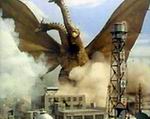
Many fans consider this the pinnacle of Toho’s Godzilla series. One would happily make a case for Ghidorah The Three-Headed Monster (1964), Godzilla vs. the Sea Monster (1966) or Destroy All Monsters (1968), but the invention and spectacle shown here are justly celebrated. Released on DVD as Invasion of the Astro-Monster, this interstellar epic features space rays, alien invaders, a science-geek hero, down-on-his-luck method actor Nick Adams, a star-crossed love “beyond all computation”, and three magnificent monsters rampaging across two worlds.
Aliens from planet X abduct astronauts Fuji (super-suave Akira Takarada, who was in everything from the original Godzilla (1954) to Godzilla: Final Wars (2004)) and Glen (Nick Adams). Stylishly clad in a leather and sunglasses combo, the X-ites ask the earthmen to lend them Godzilla and Rodan to drive out the creature threatening their planet - “Monster Zero”, a.k.a. King Ghidorah. In return they offer a miracle drug that will cure all illnesses. Back on earth, Fuji isn’t best pleased when his beloved sister, Haruno (Keiko Sawai) introduces her boyfriend, penniless inventor Tetsuo (Akira Kubo). Eager to please, Tetsuo sells his latest gadget, the “personal guard alarm”, to Glenn’s latest squeeze, the lovely Miss Namikawa (perennially popular cult film sexpot, Kumi Mizuno) who works for the mysterious World Education Corporation. Meanwhile, the Earth governments allow Planet X to transport Godzilla and Rodan inside giant, space bubbles (a striking special effect by the great Eiji Tsuburaya) for an amazing, cosmic battle with Ghidorah. But - surprise! - the X-ites double-cross humanity and announce their plans to use all three monsters to enslave Planet Earth. Oh, and the miracle drug was just a fake. D’oh! Techno-whiz Tetsuo is imprisoned after discovering Namikawa is a space-babe working for the X-ites, but he escapes with the knowledge his guard alarm gizmo could save the day. Tetsuo and Fuji launch a desperate plan to get Godzilla and Rodan back battling for humanity. Or as Glenn puts it: “We’re gonna fight to the last man, baby!”
Shinichi Sekizawa was the writer Toho called upon to deliver light-hearted, monster romps (as opposed to Kaoru Mabuchi who penned darker, message-laden, monster movies like Matango (1963) and Godzilla vs. the Smog Monster (1971)). His script for Godzilla vs. Monster Zero has one, tiny flaw (If the aliens were already hidden on Earth and able to control monsters - why bother with this elaborate scheme?), but everything else really clicks. Veteran Ishirô Honda maintains a fast-and-furious pace, utilizing highly inventive lighting and in-camera effects for scenes set on Planet X, while Tsuburaya’s flying saucers, space-age set designs, and monster battles have a retro-charm. Godzilla and Rodan’s space-flight and intergalactic tussle with Ghidorah is the mid-film highpoint, and you get to marvel at Big G’s victory dance! This was Tsuburaya’s little homage to “Ahso Matsu-kun”, a manga character he admired. Toho later issued greetings cards which featured Godzilla and co-stars Kumi Mizuno and Nick Adams recreating the dance.
What impresses most are the warm, likeable human characters (sorely missing from many Nineties and Millennium Godzilla movies), and the time taken to establish their quirky, individual sub-plots. It’s slightly surreal seeing Nick Adams, familiar from classics like Rebel Without a Cause (1955) and Pillow Talk (1959), in a Godzilla movie and hearing his gruff, Yank accent amidst a sea of dubbed voices. The torrid romance between Glenn and Namikawa adds a unique element to the usual sci-fi and monster shenanigans. Ever the method man, Adams really fell the married Mizuno and the fallout from their tragic love affair may have contributed to his suicide in 1968. Adams made three films in Japan, including Frankenstein Conquers the World (1965) and spy thriller, The Killing Bottle (1966).
He was much liked by the Japanese crew, particularly co-star Yoshio Tsuchiya (playing the alien commander). An infamous practical joker, Tsuchiya tricked Adams into saying the Japanese for “How’s it hanging?” instead of “Pleased to meet you” - which caused a group of wealthy, old ladies to recoil in horror. Adams got his own back during Tsuchiya’s scenes where he repeated the Japanese for: “You’re overacting!” Later on, Adams queried whether the studio could hire Toshirô Mifune to dub his voice for the Japanese print. “Sure”, said Tsuchiya. “Can you get Henry Fonda to do mine?”