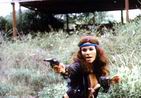
Two young women are riding a motorbike through South American countryside until they meet their friend in the middle of nowhere. All desperate to get high, they wonder where there cohort Ana (Ana Carro) is, as they know she possesses cocaine, but she's hoarding it all to herself. They track her down to a nearby location and begin threatening her with guns; she runs away but they give chase, eventually bringing her down with a bullet to the shoulder. As she lies in a daze, they begin torturing her big toe and then the leader of this girl gang appears: the self-styled Satan (Enrique Larratelli). He will take them to terrible places...
...although in 1976 there weren't many more terrible places than a cinema showing Snuff. More significant for what it spawned than what it actually was, the film's unique selling point was that at the end, once you'd sat through an hour and a quarter of filmed-in-Argentina, evil hippy thriller, you would get the opportunity to see someone killed for real. Many fell for this deeply cynical ploy and left the theatres ashen faced - not because they had seen the ultimate in horror, but because they had spent their hard earned cash to be well and truly fooled.
What Snuff was was a 1971 flick called Slaughter, created by husband and wife exploitation specialists Michael Findlay and Roberta Findlay, which hadn't sold as well as they hoped so was taken on board by distributor Allan Shackleton. Realising nobody wanted to see a cheap, Charles Manson-inspired thriller five years later, he hit upon the publicity idea of shooting a fake murder (supposedly of a female member of the crew after a scene had finished), sticking it on the end and passing it off as real. To bolster his campaign, he hired equally fake picket lines to protest outside cinemas in the hope it would catch on as a cause celebre. Which is exactly what happened, especially among women's groups.
Although anyone who had seen the film could testify to how unconvincing Snuff was, such was the power of the idea that a death could be filmed for profit that it took off as one of the most enduring urban myths since the mid-seventies. Should you wish to make it sound as if you've "seen things you people wouldn't believe", just claim to have seen a genuine snuff film and the gullible will accept whatever you say; the more sensible will write you off as a fantasist. And all because of one shoddy little film with one great way of making money, to never underestimate the prurience of the public - you'll note The Blair Witch Project used the same ploy to equally lucrative ends.
But in among all this controversy, what was the film like? Something of a muddle, to be honest, with flashbacks and digressions galore and some real oddness stemming from what can kindly be called a lack of focus, never mind budget. It starts as a story of Satan (pronounced "Sah-tahn"), the Manson figure, but then gets caught up in the tale of a Sharon Tate-like actress called Terry (Mirtha Massa) and her uninteresting career (she's so famous one reporter turns up to meet her at the airport). Along the way there is such weirdness as carnival comprising of stock footage from about ten years before by the looks of it, a police detective who doesn't have an office but sits at his desk in the doorway of a cavernous warehouse, a song that sounds as close to "Born to Be Wild" by Steppenwolf without actually being it, a discussion on the ethics of German arms dealers, and a lot of tame violence and sexual encounters. It's impossible to be involved with these characters, mainly because they are made utterly disposable by the tacked on (and tacky) finale. So there, it wasn't worth all that fuss in the end, was it?