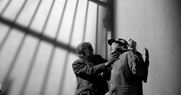
In the small, snowy town of Mountain Crest, a stranger (Steven Ritch) walks into the local bar one night and orders a drink, but then goes over to the fireplace and warms himself, looking fretful. When he's had enough of that, he makes to walk out, but the bartender stops him - he hasn't picked up his change, so he goes over and worriedly inquires if he recognises him at all. The bartender does not and so the stranger wanders out, followed by one of the larger patrons who ends up cornering him in an alley and demanding the cash he has: a big mistake, as he finds when his throat is ripped out...
The Werewolf somewhat sabotages the mystery of its plotting by giving it all away in the title, but it still has a few questions to answer, questions it sets up right away in the opening five minutes. Director Fred F. Sears was a specialist in low budget westerns, and this film could have been a traditional man hunt out West picture if it weren't for the slavering, hairy beast slap bang in the middle of it. He also provides the narration, which fills us in on the werewolf myth, as if to lend credence to the whole notion.
Perhaps the reason he did this was because this film came about right in the middle of the fifties science fiction boom, where everything had to have a rational explanation even if it was simply, "They're aliens from outer space!". This results in a scientific explanation for the unfortunate stranger's affliction and just as Michael Landon was turned into the Teenage Werewolf by the hypnotism of a mad scientist, here Ritch is transformed by the old standby, experiments in radiation.
Yes, according to this exposure to the wrong type of radiation will have you growing fur and fangs faster than you can say Lon Chaney Jr, but our monster here is more of a victim, his killing of ne'erdowells notwithstanding. The wooded landscapes are well used, with a fine sense of location and the bone-chilling bleakness of winter providing a neat backdrop to the mayhem. On the hunt for the stranger, who it turns out is called Marsh and has a wife and child driven to distraction with concern, is led by Sheriff Jack Haines, played by Don Megowan and the closest thing this obscurity has to a star in the cast.
It's as if the experiments have robbed Marsh of his humanity, because although his family still believe in him, everyone else treats him as if he were a wild animal, setting bear traps for him and eagerly looking to gun him down like a rabid dog. In fact, the werewolf is a pathetic creature, created as with much of the era's big screen abominations by science gone bad, an illustration of yet more unease with the world of technology that the man in the street might find beyond his grasp. And it's the man in the street who has become the wolf man here, an ordinary Joe who fell into the wrong hands and comes to an undignified end. It's this sense of injustice, of nobody who really matters in authority caring, that offers up this movie's captivation; it's no classic, but its anxiety is deeply felt. Music by Mischa Bakaleinikoff.