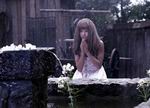
Like some long-forgotten, buried treasure, Valerie and Her Week of Wonders is ripe for rediscovery, sure to astonish and delight a new generation. Dreamy, erotic and strange, this Czechoslovakian oddity casts an hypnotic spell over the viewer, translating an adolescent girl’s hopes and fears into sublime, cinematic poetry. 13 year old Valerie (Jaroslava Schallerova) watches her first droplets of menstrual blood patter the flowers, a coming of age that seems to liberate our young heroine from time and space. Hereafter, life unfolds like a waking dream where Valerie trysts incestuously with handsome brother, Eagle and eludes a bloodsucking monster called Weasel, time-hopping through cobwebbed lairs, gothic tombs and enchanted forests.
Alice in Wonderland merges with Nosferatu, Little Red Riding Hood, and The Wizard of Oz. Weasel adopts the guise of a bishop, a constable and later a false father in his repeated attempts to ravish Valerie, but her magical earrings deliver her from all evil, including witch hunters, a lecherous priest and even her own grandmother (Helena Anyzkova). The old woman, pallid and withered like a zombie, almost a parody of aged femininity, is tempted by Weasel into betraying Valerie in return for youth and beauty. Reborn as a sexy succubus, she lures young men and women into her hayloft and feeds off their blood, while Weasel’s hold over the once-idyllic village grows stronger. Cloaked strangers hold satanic orgies in granny’s basement. Vampires cackle in their coffins.
Valerie awakens to the power of her own sensuality, breaking hearts and stirring soft-core lesbian desires. Lovely, young maidens swoon near her in church. They beckon to her from treetops and while bathing in sun-dappled pools. An angelic nymphet follows Valerie adoringly, teasing her with a phallic flower. Valerie spends a night making love to a young bride, rescuing her from the vampire’s curse. Our heroine’s eyes are opened through her fairytale adventures with vampires, witchcraft and mysticism, finally breaking the spell as the monsters melt away and her exiled parents return home. It ends with the wondrous sight of all the characters, “light” and “dark”, in the forest performing a life-affirming dance around Valerie’s bed as they awaken her from her long, dream-ridden sleep.
It is a plea that extends beyond one girl to an entire country. Valerie and Her Week of Wonders is considered the last film of the Czech New Wave, arriving in the aftermath of the Soviet invasion that crushed the creative and social freedoms of “Prague Spring”. The film is very Sixties in equating sex with socio-political rebellion, but enjoyably this leaves it titillating and weird enough to entice horror fans and cerebral enough to beguile art-house crowds. Based on a surrealist fairytale written by Vitezlav Nezval (a prominent pre-WW2 communist and scriptwriter), Valerie attacks the brutal, corrupt, authority figures embodied in Weasel and Grandmother. An aging elite out to prolong their rule by feasting on the beautiful, innocent and young. This allegory could possibly extend to Valerie’s parents, representing a generation of intellectuals and politicians who fled Czechoslovakia and abandoned the youth to terror and moral uncertainty. It is their return that restores some semblance of normality to Valerie’s life. Meanwhile, Eagle seems to embody a rebellious artist, much like Jaromil Jires himself, whose previous films were acclaimed in the West yet banned under the pro-Soviet regime. Eagle’s courtship of Valerie suggests less a queasy endorsement of incest than an artist’s loving, nurturing relationship with his country. It is Eagle who procures for her those magic earrings, “sends her notes in magic writing and coloured inks, and sings her to sleep.”
Away from politics, lovely Jaroslava Schallerova lends a universality to Valerie’s blossoming confidence and sexuality amidst a hostile world. As Valerie grows more alluring, so too does her invulnerability, culminating in a great scene where she mocks witch hunters who try to burn her at the stake. Jires’ disjointed, dreamlike images evoke what a confusing time adolescence can be - and sets some kind of record for scenes of teenage girls kissing. Yikes! Guys, this probably isn’t a date movie.
From angelic ingénues in diaphanous frocks, cackling witches, misty magic hills and sun-speckled ponds where Valerie bathes amidst floating lilies, the film overflows with arresting images, and would make a potent double-bill alongside the thematically similar, Lemora - A Child’s Tale of the Supernatural (1973). Combining sex and religion, politics with fairy stories, this magical mystery tour should be sought out at all costs.