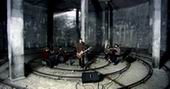
In the summer of 2006, the cult Icelandic rock band Sigur Rós decided to return to their homeland to perform a series of free concerts as a way of "giving back" to their fellow countrymen. However, the shows were not held in traditional venues for the most part, but in as many corners of the island as they could manage, ranging from up a mountain to an isloated ghost town, sometimes performing to a handful of people, and for the finale staging the biggest concert Iceland had ever seen in the capital. Then to top it all, their adventures were recorded for this film...
This was not to be confused with the epic German television series Heimat although the title meant the same thing, this was Heima, meaning homeland or "at home". Rather than a dry concert movie shot in traditional manner, director Dean DuBlois (best known for co-helming Disney's Lilo and Stitch) was assisted by the band in evoking a real sense of Iceland's landscape, and the beautiful scenery was shown to its best adavantage with some excellent cinematography as accompaniment to the music. The songs are a strange mixture of the majestic and the twee, and DuBlois had found just the right setting for them.
Famously, the lyrics to Sigur Rós songs are all made up gobbledook, which presumably means that the singer can forget the words without anybody noticing, yet also lends them a mystical quality, as if hearing some arcane spells chanted and trilled over the band's big sound. In the film, on the other hand, there was a certain attempt to demystify the band with regular interviews slotted between the performances where they would hold forth on such subjects as what it was like to live in Iceland, what it was like to perform for Icelanders and related topics on the locations they used.
It might have been better to keep this chatter to a minimum, because when the music begins to play over that landscape there's a little bit of movie magic being spun. For the the most part Heima resembles not so much a concert movie but a nineteen-seventies head movie, something like Werner Herzog's Fata Morgana without the science fiction pretensions. There is local colour present in the form of, well, the locals, who include a chap who makes musical instruments out of hundred-year-old rhubarb: more incidents like this would have been welcome.
What there is is nevertheless adequate enough, with fascinating visuals married to the powerful melodies, some created with acoustic instruments and others sounding like a full blown orchestra of plaintive or uplifting song. The most entrancing sequences are not where they play a village hall, or the record-breaking finale, but where they play in the most remote of places, such as a shipwreck, among some concrete figures halfway up a hillside, or most provocatively in a valley which soon afterwards was flooded for an electricity-making dam. Heima can easily be enjoyed as a travelogue, but also as a vaguely interpreted spiritual experience, getting back to nature or exploring a distant land; you could indulge in the stimulant of your choice to enhance your viewing pleasure. I suggest a nice cup of hot chocolate.