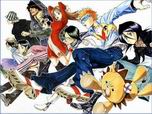
Bleach is a fast and furious manga serial that has spawned two original animated videos, two feature films, a rock musical and several video games. Now comes the TV series in a blaze of primary colours set to pumping J-rock. Mixing supernatural thrills with high school comedy, Bleach centres around Ichigo Kurosaki, an ordinary teenager (long-time anime fans say: “Yeah, right!”), introduced beating up some skateboarding punks who’ve trashed a shrine to a dead, little girl. Her ghost appears and thanks him. For as long as he can remember, Ichigo has been able to see dead people. Quicker than you can say Haley Joel Osment, samurai girl Rukia Kuchiki leaps in through his bedroom window. Rukia is a Soul Reaper, an emissary of the Soul Society. These otherworldly beings - normally invisible to humans - are tasked with leading regular spirits, or Wholes, to a peaceful afterlife in Soul Society, and to locate and exorcise evil entities known as Hollows, who devour the souls of the living and dead. A Hollow attacks Ichigo’s little sisters, Karin and Yuzo, and injures Rukia in battle, so the teen hero steps in and absorbs her powers becoming an amazingly powerful Soul Reaper. Thereafter, Ichigo teams up with Rukia as they handle high school hijinks and protect the world from supernatural terror.
Though it arrives surfing a tidal wave of hype, long-time anime fans can afford to be cynical about Bleach. Episode one has such a cookie-cutter setup: a teenager who turns out to be the chosen one, monsters of the week, an aloof co-heroine, a gaggle of high school buddies including several potential girlfriends. Even the central concept: a universe where human, demon and spirit worlds coexist, has precedent within the popular, long-running Yu Yu Hakusho (1992-95) also co-directed by Noriyuki Abe. You might think you’ve seen it all before, but stick around. From episode three onwards, Bleach suddenly subverts expectations and transforms into something deeper, more compelling and unexpectedly profound at times. Masashi Kudoh’s character designs may be bland, but the characterization is pleasingly rich.
Early episodes establish Ichigo and Rukia’s love/hate relationship. Posing as an exchange student she mingles with his friends, uses a ‘ghost pager’ to lead him on Hollow hunts, and spends nights sleeping in his bedroom cupboard. We meet the Kurosaki family, who run a small medical clinic, including Dad - a hyperactive dunce prone to sudden karate attacks upon his kids (who always beat him senseless) - and twin sisters, Yuzo - a bubbly, anime type who loves cooking - and Karin - a sullen, Christina Ricci-alike who also sees ghosts. Ichigo tours Tokyo, battling skull-masked, Lovecraftian beasties while Rukia marvels at his power. So far so bland.
Things take a quantum leap in quality with Episode Three. Ichigo’s classmates Orihime and Tatsuki are attacked by a shaggy-haired Hollow. In a neat twist, girly, squeaky-voiced Orihime shows more backbone than tomboy Tatsuki. The Hollow turns out to be her late brother, resentful that she is slowly readjusting to life without him. “Don’t you know why big brothers are born first?” growls Ichigo. “To protect the brothers and sisters that follow!” Unlike many poseurs in contemporary anime, Ichigo genuinely seems to care - an aspect that blossoms into an intriguing, series theme. Similarly, fears that Orihime will be a vacuous airhead disappear when her compassion brings about a very moving climax and leaves her subtly bonded to Ichigo in shared grief.
Episodes Four and Five tell a surreal tale involving gentle giant Chad and a talking parakeet (!) possessed by the soul of a murdered child. The rousing climax has Ichigo dispose of a slimy, leech-spewing Hollow that was once a serial killer, by shoving a bomb in its mouth. Episodes Six and Seven introduce enigmatic, magic shop owner Mr. Uruhara and his likeably oddball, kiddie helpers Jinta and Uruhu. From them Rukia purchases a ‘mod soul’, a being meant to occupy Ichigo’s body while he’s engaged with Soul Reaper duties. Unfortunately, the creature runs amok causing Ichigo no end of embarrassment until he imprisons it inside a plush toy, dubbed Kon. What could have been a tiresome introduction to the series’ cuddly mascot, becomes instead an intelligent, introspective fable where the ‘mod soul’ ponders the transient nature of its own existence. Bleach Part One reaches a high with episodes Eight and Nine, wherein the Kurosaki family visit their mother’s grave. Guilt, self-sacrifice, retribution and familial love are woven into a compelling story. While Orihime waxes lyrical on the nature of bereavement, Ichigo observes how Yuzo tries to be a surrogate mother while Karin’s brittle resilience begins to crack. Dealing with his own guilt, Ichigo confronts the little ghost girl indirectly responsible for his mother’s death and uncovers the series’ most impressively repulsive Hollow - Grand Fisher. A cracking episode, capped by a touching graveside discussion between father and son, until Ichigo’s dad hilariously declares: “Live well, son. Then go bald and die before me!”
Ichigo encounters Don Kan’Onji, a dreadlocked spiritualist with his own TV show, nationwide catchphrase (“Bohahaha!”), and rockin’ theme song. His attempt to exorcise a hospital-haunting “Demi-hollow” create havoc in the frantically funny episode Ten. In episodes Eleven and Twelve, someone is killing Hollows before Ichigo and Rukia track them down. The culprit is cold-hearted classmate, Uryhu Ishida, the last Quincy - an ancient tribe who specialized in destroying Hollows. Bearing a grudge against Soul Reapers, the powerful Ishida (also a dab hand at needlework!) challenges Ichigo to see who can kill more Hollows. Their duel continues into Bleach Part Two.
Ishida’s zeal puts innocent lives at risk in episodes Thirteen and Fourteen, when hundreds of Hollows engulf Tokyo. Busty, lovable Orihime faces down a Hollow that turns school kids into zombies and discovers compassion triggers her own supernatural powers, while across town Chad protects little Karin and finds he has superhuman strength. Mr. Uruhara recruits these neophytes into battle and they witness Ichigo and Ishida put differences aside to face Menos, a gigantic Hollow that crawls out of a crack in the sky. Like the classic Dragonball (1985-96), Bleach develops a friendship and family forged against adversity. Episode Fourteen also introduces a funktastic new closing theme: “Thank You”. Episode Fifteen’s plot attempts to be character-driven, but winds up messy and unfocused. Kon searches for a new home, Ishida rejects Ichigo’s gesture of friendship, and Orihime tries to befriend Rukia. Mostly filler, but worth it for Kon description of Orihime’s bosom as “the valley of the gods”, and the arrival of Yoruichi, the tough-talking pussycat who becomes central to the plot.
Disturbed by her growing attachment to Ichigo and friends, Rukia runs away from home, but is apprehended by two Soul Searchers in episodes Sixteen and Seventeen. Ishida and Ichigo intervene, but are left beaten and broken by Captain Kuchiki, Rukia’s ice-cool adoptive brother. The remaining three episodes have Rukia facing execution, while Mr. Uruhara trains Ichigo, and Yoruichi trains Chad and Orihime in preparation for an epic showdown. There’s a disconcerting moment when Orihime is called a hussy and attacked by one of her own fairies, but Chad delivers a priceless reaction to the talking cat: “I’m mildly traumatised by it.” Ichigo’s training features a face-off with meek, little Uruhu who is secretly stronger than the Incredible Hulk, and test where he risks turning into a Hollow. It ends with Ichigo, Yoruichi and friends departing for Soul Society - a great cliff-hanger for an exciting, inventive anime adventure.