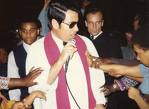
On November the 18th 1978, there occured a scandalous tragedy in the jungles of Guyana, a mass suicide that shocked the world. The leader of this self-destructive cult was one Reverend Jim Jones, a firebrand preacher with purported socialist ideals who had transferred his "People's Temple" from San Francisco to South America in 1977. But what brought the collective, which at the time of the slaughter numbered over one thousand members, to such a sorry end? Was it the monstrous ego of one man?
Understandably one of the grimmest documentaries of its day, Jonestown (also known by the subtitle The Life and Death of People's Temple) set out to relate what drove the Reverend Jones to order the deaths of all those people, but falls short of truly getting inside his head. The film used no narration, instead concentrating on the testimony of those who were there, both members and observers, and this approach was effective up to a point, but can anyone really probe the mind of someone long dead and still inscrutable?
Inscrutable because it's so difficult to empathise with a man who committed such a terrible act. Husband and wife team of director Stanley Nelson and writer Marcia Smith opt to go the traditional route, starting from Jones' dysfunctional childhood of poverty where the boy became preoccupied with death and religion ("Ah!" we can say, "So it began at a tender age!"), holding funerals for dead animals he found and occasionally killing them to do so. He felt more sympathy for African Americans than whites and held strong opinions about racism in America, which all fed into the People's Temple he set up being mainly black in population.
At first, this minister seemed like a saviour to the poor, which, we can infer, is exactly how he saw himself. Fuelled by the self-righteous power of religion, Jones was a textbook case of how a man who believes he has the backing of a divinity can go spectacularly off the rails in believing his own publicity, and the interviews we see gradually grow more bizarre: from selling pet monkeys to lure in new converts, to having sex with random members, both male and female, all under the motives that they would be doing the right thing for the organisation.
With horrible inevitabillty, the documentary moves onwards to the setting up of the Temple's "Paradise on Earth", with those involved seemingly unwilling to consider the idea that their glorious leader had degenerated in to a drug-addled, paranoid ego-tripper. The footage we see, and Nelson secured plenty of it, shows people in denial, and Jones himself, even if we didn't know what he was capable of, comes across as deeply unnerving with his sunglasses, dyed black hair and not quite lucid banter. Perhaps the best marriage of music and image is where Timmy Thomas' incredibly eerie "Why Can't We Live Together?" plays over scenes at Jonestown, posing the question of why could such good intentions became so perverted? In the disturbing tales of the survivors which follow, survivors whose families were almost wiped out by the enforced suicide, there are no easy answers. Here we might go some way to understanding what the tragedy was like as it unfolded, but not its reasoning. Music by Tom Phillips.