It's time for bed, but the little boy's father is dispirited that he wants to watch television before he goes to sleep instead of hearing a story. During the father's childhood, he tells his offspring, he was delighted to hear a bedtime story, so why should it be any different today? The father will not be deterred and takes a book off the shelf, settles down and begins the tale of The Point, where a village of pointy-headed people lived. Everything about their lives was point-related and their lives revolved around objects that tapered to a sharp end, as they did themselves. And then Oblio was born...
The Point was a pet project of singer and songwriter Harry Nilsson, and his songs featured heavily throughout this animated special. While he had come up with the fable, Carole A. Beers had assisted with realising the story and Norm Lenzer the script, and the end result had an unassuming charm in its plea for simple tolerance in life. Oblio is markedly different from his fellow villagers and everyone notices it: he has been born without a point to his head. He disguises this with a hat, but there is prejudice in the village that won't be ignored.
Most of the community have no problem with Oblio, that is until he and the son of The Count (Lennie Weinrib voices with a spoofy Laurence Olivier as Richard III impression) have a triangle-throwing match that ends with Oblio the victor. Never mind the son, The Count is highly dissatisfied and falls back on an old law that banishes non-pointy heads from the land. A trial is held and everyone is sad to see the boy go - except The Count - but the law is the law and they can't argue with it. So Oblio and his dog Arrow are sent to the forest as punishment.
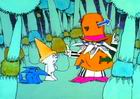
That'll be punishment for not having a pointy head, then. The allegory here is undeniably hippy-dippy, but eccentric enough to hold a measure of charm that carries it through seventy-five minutes or so of animated adventure. When Oblio turns up in the forest, the film really goes into Alice in Wonderland meets Yellow Submarine territory, with sketchy-looking but winning characters thrown into the hero's path at every opportunity, some with a lesson to teach and others seeming more like oddness for the sake of novelty alone.
There's a rock man, a man made of stone who speaks the moral of the film, that is you don't need to have a point to have a point, that title naturally being a play on words. Also a trio of bouncing balloon ladies appear, as does a tree man who values leaves as his fortune ("Leaves like that don't grow on trees!") as all the while Nilsson's amusing, wistful songs play on the soundtrack (the project started as a concept album). Oblio's reason for existing, his point, is to bring down the prejuduce against him and after his day in the forest you'll be glad to know there's a happy ending. There were a variety of narrators to The Point, originally Dustin Hoffman on its television debut, but Ringo Starr is the one you'll most likely hear, warming up for Thomas the Tank Engine. Overall, it's sweet-natured and imaginative and deserves to be better known.