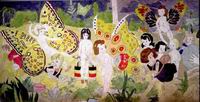
Henry Darger was an elderly recluse. He spent his childhood in an Illinois asylum for ‘feeble-minded’ children and his adulthood working as a janitor in Chicago. He lived a quiet life alone in his apartment, while neighbours regarded him as a harmless eccentric. But when Darger died in 1973, his landlady discovered three hundred paintings in his room, some over ten feet long, and a 15,000-page illustrated novel called The Realms of the Unreal. Darger’s magnum opus tells the epic story of the virtuous Vivian Girls, seven angelic sisters who lead a rebellion against the cruel, child-enslaving kingdom of Glendillinia. Bursting with colour and imagination, Realms of the Unreal was exhibited in art galleries and went on to inspire poems, music and plays.
Jessica Yu’s award-winning documentary offers a portrait of one man’s astonishing inner life. Storybook narration from child star Dakota Fanning sets the tone. Yu adopts an engaging, fable-like structure and weaves portions of Darger’s autobiography read by Larry Pine, interviews with his surviving neighbours, still photographs (only three pictures of Darger exist) and animated excerpts from The Realms of the Unreal, into a moving picture book. As a man, Darger remains a mystery even to those who knew him. Many of those interviewed here can’t even agree how to pronounce his name, or on small details like where he sat in church. Darger himself sometimes claimed his real name was Henry Dargarus and that he was born in Brazil. Most describe him as unconscious of his surroundings, a man who held imaginary conversations alone in his apartment, adopting different voices, sometimes in made-up languages. Documentary footage, going from the early nineteen-hundreds to the mid-seventies, parallels Chicago’s development into a major metropolis with the growth of Darger’s staggeringly elaborate fantasy world.
An entirely self-taught artist, Darger drew inspiration from his collection of storybooks, vintage ad material and children’s comics. This was the golden age of children’s illustration. His artwork echoes Mabel Atwell, Cicely Mary Barker and even Disney artist Carl Barks. Darger’s experimental use of collage, Xeroxed images, and daring compositions mark him as a pop art precursor to Warhol. Yet amidst a painted landscape sprinkled with whimsy and odd beauty, there also lie frightening images of child enslavement. Little girls are bound with ropes, strangled, or dragged by horses. Yu suggests Darger’s fiction was his means of dealing with his own sad childhood, particularly his orphanage days, and also his unfulfilled desire to adopt a child. Darger writes movingly about the sufferings of children, while his inventions, the Blingens - fantastic flying creatures who protect youngsters with ‘a mother’s love’- reflect his own yearning for some form of maternal warmth. Far from a simpleton, Darger’s autobiography shows him to be sensitive and erudite, and yet also innocent. His magical little girls were drawn with male genitalia. Though his cultured landlady interprets them as an attempt to merge genders, the film also suggests Darger simply didn’t know the difference between the sexes.
As with the illustrations, Darger’s text draws from disparate elements: the Oz books, Uncle Tom’s Cabin, Charles Dickens, and his own religious faith and occasional doubts. Though Darger’s heroes, the Christian kingdom of Abiyania, fight a holy war the author continually questions whether god is on their side. Is the saga a metaphor for Darger’s struggle with his Catholic faith? An attempt to reconcile the disappointments dealt him over time? Or a simple piece of escapism for a lonely, old man? This documentary succeeds in bringing the Realms of the Unreal to life, while leaving us free to draw our own conclusions from this magical journey.