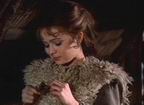
Cinderella (Libuse Safránková) lives with her wicked stepmother and ugly stepsister Dora on the estate left to them by her late father, but rather than reaping the rewards, she is relegated to performing menial chores and put upon by her guardians. Today the King is arriving and the stepmother is expecting the Prince (Pavel Trávnicek) to be with him - Dora is on the lookout for a husband after all, and he would be ideal for her. Whether she would be ideal for him is another matter. Cinders is set another trivial but time-consuming task, but allows her friends the doves to help her: she doesn't know it, but she is living a charmed life...
In certain European countries Three Wishes for Cinderella, or Tri orísky pro Popelku as it was called in its native Czechoslovakia, is the equivalent of The Wizard of Oz in Britain in that they show it on television every Christmas; it's a tradition now. However, although it has been shown elsewhere, the film's profile is not quite as high as it is in say, the Czech Republic, Slovakia or Germany. It's a variation on the Cinderella fairy tale that swaps a fairy godmother for a selection of three hazelnuts - not quite as glamorous, perhaps, but less of a fuss.
The Prince is almost as big a character as Cinderella in this version, and they encounter each other three times, with each instance the Royal not knowing who this girl is, until the requisite happy ending. It was directed by Václav Vorlícek, something of an expert in Czechoslovakian fantasy cinema, from a script by Frantisek Pavlicek adapting a story by renowned Czech writer of the nineteenth century Božena Nemcová. The film keeps that authentic folk tale atmosphere throughout with its sparingly-used special effects and lavish costumes.
And snow, lots of snow. Maybe this is why it has survived as a Yuletide tradition, as it's like a story told around the fireplace on a a wintry night - perhaps Christmas Eve. The beautiful Safránková makes for a plucky heroine, whose magic hazelnuts give her three outfits to wear, first a huntress's clothes for a meeting with the Prince in the forest, then a ballgown for the event held up at the castle, and thirdly, well, that would be telling. You can see where the better known version of Cinderella intersects with this one.
After all, Cinders does go to the ball and dances the night away with the Prince, although she wears a veil to protect her identity. And when she flees, she leaves a shoe behind which the Prince picks up and looks for a young lady whose foot it will fit. But there's a progressiveness to this rendering, where the heroine doesn't simply wait around to be swept off her feet but takes a more active interest in securing her future happiness. She's also in touch with nature, as witnessed by her communing with birds, a dog and her horse, given to her by her late father, and the way she saves a deer from the Prince's crossbow bolt. She doesn't manage to save the unlucky fox, however. Overall, once you get used to the differences between this and the version you know it's very predictable, but that's part of the charm of oft-told tales. Music by celebrated Czech composer Karel Svoboda.