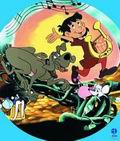
Come on, you know the story! Daydreaming farm boy Jack trades his cow to a sinister travelling salesman in exchange for some magic beans. His mother scolds him, throws the beans out the window and overnight they grow into a giant beanstalk. A mouse in medieval maiden’s garb climbs down and entreats Jack’s dog, Crosby (who, like a Vietnam veteran, has flashbacks to his days as a war-dog), to lead Jack up the beanstalk. Jack and Crosby discover a kingdom in the clouds, where evil witch Hecuba and her monstrous son Tulip have seized control. Young Princess Margaret has been hypnotised into seeing Tulip as a handsome prince, and Hecuba has transformed all her servants into mice. Now she plans to marry the little princess to Tulip. Impetuous Jack has his eye on the castle treasure, but Crosby persuades him to rescue Princess Margaret from an array of ghouls and goblins, and break the spell before her wedding day.
This marvellous musical anime is a cult film in the States thanks to frequent screenings on HBO. It marked the feature directing debut of Gisaburo Sugii, an animator not as well known as Hayao Miyazaki, but almost as important. Sugii went on to become one of anime’s most versatile auteurs, helming classics like Night on the Galactic Railroad (1985) and Tale of Genji (1987) and fan-pleasing nonsense like Street Fighter II (1994). His most distinctive works display a Looney Tunes-style zaniness well in evidence here, with spirited sight gags and slapstick surrealism. Highpoints include Crosby’s solo number: a moving soliloquy about bravery, honour and standing up for what’s right, curtailed when he realises Jack and his mother are listening (“Crosby, you can talk!” “Uh… woof woof.”). Princess Margaret’s spellbound sing-along, praising Tulip’s virtues as a fiancée, and the wedding song performed by ghouls made out of paper are memorably creepy. This is a rare anime musical with songs woven properly into the plot and more substantial than bubblegum pop.
Sugii’s characters are peppier than the average fairytale heroes, but never as obnoxious as those in the Shrek series. Jack may be greedy, lazy and self-serving, but undergoes a genuine emotional journey, and is transformed through his relationship with noble Crosby and romance with level headed, altruistic Princess Margaret. In what plays like a twist on Romeo and Juliet’s balcony scene, Jack and Margaret share a musical debate about each other’s values, with the boy steadfastly refusing to become the hero we expect him to be. The film proves there is more to entice adults to animation beyond a cynical skewering of fairytale morality, and the character arcs are surprisingly mature and moving. In the poignant conclusion, Margaret rejects Jack’s romantic advances, choosing to stay and help her people. Jack now knows what is right and wrong, yet it isn’t Margaret he loves, it’s the idea of being a hero. He winds up back home, still sunny and carefree, but a little wiser. Jack and the Beanstalk is one of anime’s secret treasures, and perfect family entertainment.