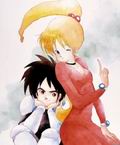
On the distant planet Aqualoid, space teens Namu Shurugi and Rasa Jupiter are caught in an intergalactic war. Organics and Inorganics are battling over a mystical talisman called SHADE, which Namu recovers from a fallen star. Namu, Rasa and comedy relief blob-thingy Monga are pursued by Inorganic death squads, but Arlia, an all-powerful alien super-being becomes their protector and guide. She reveals whoever possesses SHADE is destined to rule a galactic empire. Our heroes hook up with accident-prone treasure hunter Bao and his sidekick Kim for a madcap chase that incorporates fast-paced action, hi-tech hardware, mystical meanderings, surreal humour (a pint-sized Inorganic who wants to be loved) and, as The Anime Encyclopaedia observed, “frequent shots of Rasa’s cute rear end.”
A trippy dose of psychedelic sci-fi, Birth was a pet project for veteran animators Shinya Sadamitsu and Geki Katsumata. The 1980s were a boom time for anime in Japan, when new peaks of creativity and financial success gave birth to the OAV (original animated video). A cash cow for a hungry industry, OAVs also provided a fresh forum for creators to experiment and raise the bar, artistically. Young Japanese were embracing anime for its infinite possibilities, much as sixties youth latched onto rock and roll. Toiling away by day on “super-robot” shows for kids, Sadamitsu and Katsumata conceived their side project as a free form jam session. Loosely structured around a comical space opera, Birth bombards viewers with Buddhist philosophy, experimental animation and musings on the transient nature of existence. Alongside familiar, crowd-pleasing anime tropes like cute aliens, transforming mecha and elfin sexuality. It is the anime equivalent of a “head movie”, a cosmic freak-out squarely aimed at hardcore fans happy to ponder its myriad meanings.
Stephen King once wrote that all fantasy fiction concerns power. Bad fantasy has heroes gain power then blast people with it. Good fantasy has heroes find power at great cost. Birth rather cleverly subverts the whole concept, as it transpires the quest for SHADE is merely a trigger that begins each new cycle of existence. The movie concludes with the central characters realising ultimate power is merely an illusion, surviving the apocalypse to live on as spirit forms while Arlia prepares the way for the next cycle. At least that’s one interpretation. Re-titled Planet Busters for its UK and American video release (it has also been known as World of the Talisman), the script was revamped as good guys versus evil robots. Some critics claim neither version makes a lick of sense. Others contend that beneath its philosophical pretensions Birth is nothing more than a non-stop chase. Nevertheless, the OAV was a cult success in Japan and enjoyed limited theatrical screenings. In the late nineties its soundtrack – early, chilled out, mid-eighties groove from Miyazaki’s regular composer Joe Hisaishi – was reissued on CD, enticing many a club kid onto the dance floor. Two decades on, Birth remains a wild ride, although anime virgins should seek out a less frenetic bop to pop their cherry.