Here in seven chapters we will be told the history of witchcraft in Europe, specifically the Middle Ages, but also of how it relates to the present day. During Ancient times, belief in devils was rife and they were depicted in religious art right up until the era we are concerned with here. During those years, the population of Europe were committed Christians and it was accepted that the planet Earth was the centre of the Universe, with Heaven above and Hell below, but the faith in God did not prevent superstition plaguing the lands - if anything, it made it all the more prevalent...
Audiences of the 1920s had quite a shock when Häxan, or Witchcraft Through the Ages as it was known in English (Häxan means "Witch"), was released because for its day it was pretty racy stuff. It was the brainchild of ex-opera singer (he gave it up due to stage fright) turned filmmaker Benjamin Christensen, funded by Swedes but shot in his native Denmark, and presented as a serious minded examination of precisely how so many people were tried and in some cases executed as witches a few hundred years before.
It begins rather dryly with a selection of artworks from history depicting witches, demons and the Devil accompanied by authoritative-sounding captions, but after a while the dramatisations are set in motion. These show actors and actresses dressed up to look as if they hail from the Middle Ages, yet Christensen wants to have his cake and eat it too, because while he illustrates the injustice of a witch trial, he also illustrates the sort of thing the accused were thought to be getting up to, so we can be entertained (or suitably appalled) by both sides.
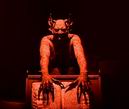
For the Devil's side of things, there are scenes of him and his minions going about their business, indulging in such things as frightening the life out of monks, visiting sleeping young women in their beds, or having their arses kissed during black masses. In addition to such meetings, the witches are also seen making potions out of various disgusting ingredients, and selling them to, say, a woman who wants a monk to fall in love (or lust) with her. So the dark arts are given a thorough run through, but more to the fore are the terrible acts carried out by the Church against the falsely accused.
Therefore a bedridden printer's illness is blamed on an elderly weaver passing through town, who is arrested, tortured and forced to confess even though she's an innocent old woman. Seems like every society needs its scapegoats, and women in general are the unlucky ones here, and not only the older ones either, as evinced by scenes of two young sisters accused and punished, with those unwilling to testify against them arrested as well. It's a miracle that there were any females left back then, but Christensen jumps forward to the twenties to explain the behaviour of those executed for witchcraft by way of modern psychology, suggesting that we still treat those under psychosis or stress badly. Whether you accept that or not, it's still the bizarre images you'll take away from Häxan, such as the multitude of witches flying on broomsticks over a village at night.
[Tartan's Region 2 DVD features both the original version and the shorter 1968 version, narrated by William Burroughs.]