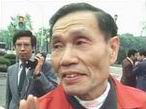
62-year-old Kenzo Okuzaki is a very angry man. He is happy to admit that he has spent thirteen years in prison, ten years hard labour for murder, and a further three for firing pachinko balls with a slingshot at Emperor Hirohito and for distributing flyers featuring the Emperor in pornographic situations. Indeed, he's very keen to let this information be known about himself, as he seeks all the publicity he can for his mission. At the end of the Second World War he was in New Guinea with the Japanese Army, and there occured a series of atrocities he is determined will never be forgotten...
Whatever you think about the confrontational antics and interview techniques of the likes of Nick Broomfield or Michael Moore, at least you couldn't say they physically attacked the subjects of their enquiries. Not so with Okuzaki, as here he dominated director Kazuo Hara's grimly amusing and occasionally disturbing film of his investigations, though he was such an extreme personality that it was difficult to know how to react: was he funny? Or a tragic crusader with belief in divine retribution in a land that would rather have forgotten exactly the injustices he was highlighting with his every waking hour? Or was he perhaps being exploited by a director in search of a good story?
We first see our protagonist at a wedding, giving a speech starts congratulating the happy couple and then goes off on a tangent about how "nations are a wall between men", then moving onto to criticise the traditional family unit. This gives you some idea of his would-be iconoclasm, as do the following scenes where he stages his own one-person parade on his perceived nemesis Hirohito's birthday in a van covered with anti-Emperor slogans on billboards. Naturally he is stopped by Tokyo police, who stand about bemused as he rants at them.
After a while a thread emerges, a true reason behind his rage. He becomes obsessed with exposing the illegal murder of Japanese soldiers in his former regiment; he boasts about attacking his officers way back when in a way that you not only believe, but wonder how he wasn't one of the victims. Kazuo takes his time in revealing what precisely went on in those jungles thirty seven years before his film was lensed, yet eventually you understand that there were scandalous killings by the military, and that there was a decidedly gruesome aspect to it all.
As Okuzaki sets about interviewing his former officers and the relatives of those who were shot, the story grows clearer, even if he has to beat it out of them. In bizarre scenes, his apologetic to a fault countrymen welcome this character into their homes, bowing politely as he responds in kind, only for him to grill them, make threats and in some cases resort to violence. During the last half hour, where he secures the proof from an ex-soldier that the Japanese military were covering up cannibalism in their ranks due to the lack of food at the time, he thumps the truth out of his interviewee, a man recently out of hospital who has to return there after Okuzaki's visit. He may get his answers, but he doesn't get his justice because people simply don't want to know. He died in 2005, probably still unsatisfied. As a portrait of a deeply flawed yet righteous individual, the film goes beyond eccentric and into darker areas of national guilt and uncomfortable, lingering memory - not an easy watch, but an absorbing one.