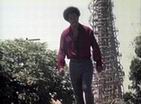
Charles Murray (Marlo Monte) sits on a wall on top of a high building and threatens to jump if the cops don't back off. They have brought along his girlfriend Carmen (Reatha Grey) to talk him down, but will he listen to her? As he balances there, he remembers the events that have brought him to this sorry point: three years ago he was a low level dope pusher with few prospects - and he knew it. He met his friend in a hotel room for a deal, but they noticed undercover cops outside ready to pounce, so made up their minds to flee. Charles, however, didn't get away and was captured by the cops Jim (Stan Kamber) and Harry (Ben Bigelow), who was aggressively racist and determined to take out his frustrations on Charles no matter what...
If Welcome Home Brother Charles, retitled as Soul Vengeance, is recalled for anything it will be the highly unusual weapon its main character uses, which is strongly hinted at by the appearance of a distinctive statue under the opening credits. It was the first film for writer and director Jamaa Fanaka, whose work, largely in what would be termed the field of blaxploitation, was distinguished by apparently sincere weirdness. He was best known for the prison-based Penitentiary series, but on what was essentially a student film he was working on an even lower budget and for much of the running time it looks like a socially conscious drama highlighting the plight of the black lower classes.
Yes, Charles is involved with crime, but he sees the error of his ways after a spell in jail. Before he gets there, however, he has to suffer the indignity of Harry beating him up and in a fit of rage attempt to cut off his manhood. He doesn't succeed, but as Charles heals in prison he nurses his wrath against the Man who has put him inside and undergoes a spiritual awakening. He will now turn against his old life of drug dealing and try to go straight; well, apart from seeking revenge on those who put him away, that is, so he's not entirely given up his life of crime, it's just that this time it's personal. When he does get out, after a montage of images Monte looking anguished in his cell accompanied by a theme written by Fanaka that sounds like a foghorn being set off, Charles finds things are different.
Now all his old friends are deeper into the crime scene than ever before, but he makes a connection with Carmen, a prostitute who tried to help him when he was being arrested, and soon that relationship turns to love. However, what has been a fairly clichéd picture of urban strife is tipped into the world of the weird as Charles now has superpowers. I don't want to spoil anything, but as far as I know Superman never combated Lex Luthor this way, so the good folks at Marvel and D.C. Comics might want to check this film out for some new ideas for upcoming characters. Suffice to say the scenes where our hero secures his revenge are certainly hilarious and it's safe to say nothing like this was ever tried before on screen, and I don't recall it since. Otherwise, the tension between the life of a con and an ex-con is somewhat dismissed when Charles' mystical talent is introduced, but nobody would have paid attention to the film if it hadn't. File under "Odd". Other music by William Anderson.