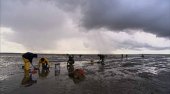
During the night of February the 5th 2004, twenty-three Chinese illegal immigrants were drowned when the Morecambe tide overtook them. The reason they were out there in such dangerous conditions is that they were cockle picking, a highly lucrative industry, and this film follows one woman, Ai Qin (Ai Qin Lin), as she travels from her home in China across Asia, sometimes by bus but often on foot, to reach Britain. All because since her husband has left her with a child she cannot afford to look after, not to mention her parents who rely on her, now she is forced to seek work abroad. Her contact makes it sound like she will soon be making a lot of money as an immigrant, but the reality is sadly far different.
When that story about the drowning Chinese hit the headlines, most British people could hardly believe that the mundanity of cockle picking had led to such a terrible loss of life, and hadn't given the origins of the food they put on their table much thought. For it was not only cockles that these illegals were involved with, but as this film shows many other apsects of the food industry as well. Nick Broomfield eschewed his usual confrontational documentary style for an equally realistic drama, well researched and as faithful to the experiences of the immigrants as possible. That said, the explanatory captions dry up just as they should be becoming more prevalent.
When Ai Qin reaches Britain she finds herself not rolling in cash, but sleeping in a house with twelve other people on a mattress on the floor, and not only that but she has to pay for it as well. She is given - sold, actually - a work permit that doesn't even bear her name or photograph, and sent to an agency whose staff are happy to accept bribes in return for job opportunities. Those jobs are at the lowest end of the social scale, night time shifts at meat packing plants or picking spring onions and apples for supermarkets. All the while the immigrants have to put up with abuse from racist Britons (the "ghosts" of the title - as these Chinese are ghosts to most Britons) and the threat of being raided by the police.
There are many tear-jerking scenes that lean closely to sentimentality, but which probably coudln't be avoided considering the subject matter, and it is finally undeniably moving as we see the cockle pickers fatally forced to work at night due to being attacked by the other, British pickers during the day. Most illegal immigrants will never see the families they are working so hard to help ever again, and it's not all food gathering they're caught up in: Ai Qin is nearly dragged into the sex industry as well. The fact that the Chinese who died still owed money to the human traffickers and the British government refused to help out their families with the debts is just one last indignity in a series thay they had to endure. Broomfield's film is never less than convincing, and should prove an eye-opener to the majority who never give a thought to where their food comes from beyond a trip to the local supermarket.
[Tartan's Region 2 DVD has an excellent making of featurette and a trailer as extras.]
Pioneering British documentary-maker known for both the relentless pursuit of his subjects and his eagerness to put himself in his films. Broomfield's earliest films were observational documentaries covering such subjects as prostitution (Chicken Ranch), army life (Soldier Girls), and comedienne Lily Tomlin (Lily Tomlin). 1988's Driving Me Crazy introduced the style of film for which Broomfield would become famous, as he detailed his own failed attempts to film a musical.
Subsequent movies include two studies of serial killer Aileen Wuornos, the Spalding Gray monologue Monster in a Box, controversial Fetishes and a pair of documentaries on musical themes, Kurt & Courtney and the rap-exposé Biggie and Tupac. Broomfield has also made two forays into fictional film-making, with 1989's woeful thriller Diamond Skulls and 2006's true life immigration drama Ghosts. He returned to a true murder theme with Tales of the Grim Sleeper.