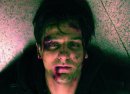
A drunken young woman tries to open a bottle of champagne while riding down an escalator on the Budapest Metro, and after a lot of effort, succeeds. Once she reaches the platform she wanders to the edge and awaits the train but when it finally arrives, she is nowhere to be seen... Later that morning, but still early, Bulcsú (Sándor Csányi) awakes from his slumber on a different platform as a train pulls in, and when one of the departing passengers points out in passing that his nose is bleeding, he gets up and follows him. The passenger doesn't get away, and Bulcsú confronts him - asking for his ticket. He is one of the Metro's much maligned ticket inspectors, but things are growing steadily worse for him...
There's a chap at the start of Kontroll, a representative of Budapest's Metro, who is keen to point out that this is a work of fiction and the events depicted in this film are not the kind of thing that goes on in the real Metro. Nevertheless, he thinks that despite protests from his colleagues, this film has artistic merit, and he's not wrong. Written by director Nimród Antal, an American in Hungary, the landscape, if you can call it that, is one of a limbo that might be moving towards heaven or hell, it's all a matter of how Bulcsú copes with what life is going to throw at him.
And judging by his progressively more bloody features, he's going to have a lot of soul searching to do once the story is over. This starts as a serial killer thriller, with a mystery man pushing unsuspecting commuters into the paths of oncoming trains, deaths the authorities believe to be suicides, although we know better. At a meeting of the Metro staff early on, the chief tells them (and us) that there have been seven deaths in this way so far during this spate, and they don't want there to be any more. Some hope. Then the atmosphere changes to comedy, and a pretty good television sitcom could be made from the adventures of these hapless employees.
Bulcsú is part of a team who seem to meet every troublemaker imaginable, from pimps and their prostitutes to Japanese tourists who speak no English, to a man unable to get past his stutter to communicate, to a deaf and dumb couple - it appears that hardly anyone wants to pay up for their tickets and will go to great lengths to avoid parting with their fare. So the narrative settles into a selection of encounters between this team and the public who make their jobs something of a challenge, not least the football hooligans who beat them up. Then there's Bootsie, a prankster who prefers to spray the inspectors with cream than hand over the cash, leading to a well-shot chase around the underground.
When that Metro representative at the start says that he believes the drama is symbolic, therefore not a true depiction of life on the subway, you think, yeah, sure, you've just been told that so the filmmakers can create all sorts of mayhem for their movie. But after a while, you see he has a point: Bulcsú is afraid to venture out of the station and we get hints that he may have left a successful life behind because of the pressure he couldn't take, so his situation is a metaphor for his inability to face up to his responsibilities and his demons. Eventually the killer makes a reappearance and Bulcsú is mistaken for him, cranking up the tension once more, and Kontroll operates on the levels of humour, drama and suspense, all equally successfully, Perhaps that metaphorical aspect is a little pat and as a story it could have been pared down further, but Antal fashions a striking world without ever leaving its claustrophobic environment. Music by Neo.