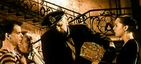
Anton (Denis Lavant) lives and works in an Eastern European bath house, and quite a lot of that situation is to do with the fact he's too scared to leave it. The establishment belongs to his blind father (Philippe Clay) who believes that business is booming thanks to the strenuous efforts of his son and wife to keep up the illusion with the help of a tape of a busy swimming pool and much contrived splashing about. And what thanks does Anton get? Usually a slap in the face from his father when the boiler overheats or some other minor misdemeanour. Today a young woman, Eva (Chulpan Khamatova) arrives with her elderly father to visit the baths, and for Anton it's love at first sight, but he will soon have other things to occupy his mind - the proposed demolition of his home, for example.
The closest thing a lot of viewers had to compare Tuvalu with was Delicatessen, as it is set in a similarly ramshackle environment, has a curious sense of humour (so much so that you wonder how much is supposed to be funny), and the same, fully realised depiction of its world. It was scripted by the director Veit Helmer and Michaela Beck and resembles a fable as told by Frank Capra, if Capra had grown old enough to turn loopy and had hailed from Germany. The moral would appear to be one against the attractions of greed, and a plea to follow your heart - typical fairy tale stuff, really.
The film is almost entirely shot in black and white, coloured with tints depending on the location, which adds to the eccentric and decaying atmosphere. There are aspects that would not be appropriate for a fairy tale, not one for children anyway, as when the smitten Anton hides under a hole in the changing room floor to get a sniff of Eva's brassiere that has fallen down as she dried off - surprisingly, she finds the resultant tug-of-war pretty amusing. And the intermittent dialogue is not in any recognisable language, as it is made up of various words that are understandable but not consistent.
This is a kind of romance, but for some of the time the characters motivations can be murky - does Eva like Anton or not? But Anton doesn't have time to think about his potential love life when his brother arrives to take his father to attend a demoltion of a nearby tower block, a building in similar state to the bath house and one where Eva and her father live. Or used to live, as Eva's father's attempts to chain himself to a door to stop the destruction fail miserably. And when the dreaded Inspektor is invited round to Anton's place, the writing would appear to be on the wall.
Especially as Anton's brother is determined to knock the place into shape, even if it means knocking it down. Anton's mother often takes buttons as payment for entry into the bath house, otherwise there would be even fewer patrons in there than there already are, but the brother finds this an intolerable state of affairs and sets up a new ticket machine to replace her - this after making sure that rubble fell from the swimming pool ceiling when the Inspektor was there, killing Eva's father in the process. Does he want it closed or not? Watching Tuvalu is a bit like having a story roughly translated from a foreign original, with odd details and motivations, and the finale makes the efforts of Anton seem somewhat pointless. But the film has charm, is well acted and looks particularly fine, with many enchanting and arresting visuals - it just needed more work in the script department. Music by Goran Bregovic and Jurgen Knieper.