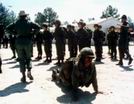
This is the story of the new female recruits of Charlie Company in Fort Gordon, Georgia and their basic training. They are addressed at the start by a higher ranking officer who tells them what to expect and how by the end of their training they will be ready for combat - the United States has never lost a war, he avers, not even the conflict in Vietnam as that was a purely business matter. But as the film draws on it becomes obvious that a fair few of the women who signed up didn't realise how tough the army life would be, and not all of them will make it through to the end...
Soldier Girls was one of the earliest of the Nick Broomfield documentaries, this one co-directed with cinematographer Joan Churchill, but the recognisable Broomfield style is still in its nascent form. He is not the centre of attention as we follow him through the lives of his subjects, here he and Churchill stay in the background to let the people involved speak for themselves. He does appear, carrying his trademark microphone, in one scene near the end, so who knows? As he edited this feature as well, perhaps the sight of his face in this gave him an idea.
There is no narration, either, but we get to know the soldiers pretty quickly. The least suited to military life would appear to be Private Johnson, who can't help but smirk as she and her comrades are shouted at by the sergeants, which naturally gets her into trouble. Another private, Alves, seems ill advised to have joined up too, as she takes the "can't do it, won't do it" attitude and is subsequently punished for lack of motivation. But then there's Private Hall, who we see early on comforting a tearful soldier but goes on to lead the company with a firm hand.
The main theme seems to be the dehumanisation of the recruits as they are shaped into a fighting force. They are instructed to disregard their emotions, especially when the harsh conditions prompt them to break down, and the training we see includes everything from marching to learning how to bite the heads off chickens. The recurring order is to do as they are told, and the recurring reason is that if they don't they will get their fellow recruits killed - they must be reliable to be a member of this army, but as the sergeant points out when he opens up near the end, this can come at some cost.
Perhaps because it features women being treated as men, Soldier Girls used to have a certain shock value, but now if you've seen Full Metal Jacket you'll pretty much expect the way they are treated to be the norm. They are taught how to deal with a nuclear bomb going off, but the lesson is not much more useful than a "Duck and Cover" exercise of the nineteen-fifties; the fact that none of the soldiers point out how dubious the advice is serves as testament to their compliance. It may be unsettling to see Private Johnson surrounded by her superiors and harangued, but they have a point: if she was acting like she does in a combat situation, she would be in danger of getting someone killed. The most useful function the documentary serves is to illustrate to those thinking of joining up just how unforgiving the military life is. If you have second thoughts after watching this, then perhaps it's for the best.
Pioneering British documentary-maker known for both the relentless pursuit of his subjects and his eagerness to put himself in his films. Broomfield's earliest films were observational documentaries covering such subjects as prostitution (Chicken Ranch), army life (Soldier Girls), and comedienne Lily Tomlin (Lily Tomlin). 1988's Driving Me Crazy introduced the style of film for which Broomfield would become famous, as he detailed his own failed attempts to film a musical.
Subsequent movies include two studies of serial killer Aileen Wuornos, the Spalding Gray monologue Monster in a Box, controversial Fetishes and a pair of documentaries on musical themes, Kurt & Courtney and the rap-exposé Biggie and Tupac. Broomfield has also made two forays into fictional film-making, with 1989's woeful thriller Diamond Skulls and 2006's true life immigration drama Ghosts. He returned to a true murder theme with Tales of the Grim Sleeper.