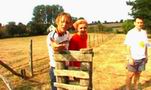
It's another morning in the House, a live, reality television show that has evicted its latest contestant the previous evening. As the time is the near future, the show has devised an innovation: the cameras are implanted in the eyes of the participants, so we see everything from their point of view, making the action come across as all the more immediate. There are now five contestants left and with a week to go before the next eviction, they all can't help but wonder who is going to be the eventual winner. They've been through a lot together, and now beginning to get on each other's nerves, but just how far will they go to be stars?
If you've watched Humphrey Bogart in Dark Passage and thought that the film would be better if it stayed in point of view camera throughout, and it would be better if a whole film were made this way, then La Maison could be for you (presumably the contestants have microphones in their ears as well). Written by Arnaud Boulin and director David Henri, it will also help if you're familiar with the workings of reality television such as Big Brother, which is the most obvious derivation of the story. There's no diary room here, no voice over the intercom to tell the housemates what to do, just a letter delivered every day to the farmhouse where they live.
This letter usually contains a code which corresponds to an instruction printed in a large book, an instruction that must be carried out by the contestants. It could be something like doing fifty press-ups, running round the house backwards a few times, or abstain from drinking for a whole day (if they're desperate they can drink water from the toilet). The whole point of view thing doesn't take long to get used to, and just as in the genuine Big Brother nobody wants to be evicted, alliances are formed and broken, and there's bitching behind other contestants' backs.
A certain monotony sets in after a while, broken up by suspicions about the nature of the show they're on - we get hints that some housemates haven't entirely left of their own accord, and we never see anyone other than the five characters, except for a figure in the distance in one scene. There is a sixth participant, of course, but how willing Trash the rabbit was to be a movie star is uncertain, especially as he is killed and eaten some way into the film. Things take a sinister turn when the instructions lead to damaging actions, and the filmmakers apparently ask how far people will go to be stars on TV, but don't ask why they would comply with the increasingly dangerous orders - surely eventually someone would say, "No!" before what occurs at the grim ending? As far as it goes, La Maison holds the attention and is convincing within the boundaries of its own world, but I'm not convinced it contributes much to the reality TV debate.