There's evil abroad in the small Mexican town of Sycamores, and the townsfolk are afraid to venture out after dark because of it. But Marta (Ariadna Welter) knows nothing of this when she arrives by train at the nearest station, wondering if there is any transport into the village where her sick aunt lives. The stationmaster tells her she'll just have to wait, and as coincidence would have it, there's a chap, Enrique (Abel Salazar) waiting on the platform in the same predicament. Luckily, a cloaked man with a horse and cart draws up, looking to collect a large crate filled with earth from Hungarian forests, and he agrees to give them a lift - but is it such a good idea?
Credited as the film that started Mexico's line of horror movies during the late nineteen-fifties, El Vampiro was scripted by Ramón Obón and looked to the more traditional Hollywood fright movies of the nineteen-thirties and forties for its inspiration. Mexican society's preoccupation with death also comes through here, as the film pretty much begins with a funeral, held at night despite us being told at the outset that nobody in Sycamores goes out after dark. I suppose they made an exception to bury who we later find out is Marta's aunt, who has succumbed to her illness even before her niece arrives at the now-rundown family estate.
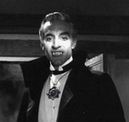
The man with the cart unhelpfully drops Marta and Enrique off a good distance away from their destination, leading to a fraught with worry walk through an extremely atmospheric forest set. Everything about this film is atmospheric, in fact it's the design that is production's strongest suit, with rooms full of cobwebs and dusty books, tombs lit by torches, and bedrooms with windows that fly open without warning. We are aware from the credits that this is a vampire movie, not simply from the title, but also because we see the dreaded Count Duval (Germán Robles) feasting on a victim right away. A nice touch has his hair turning from steely grey to black whenever he feeds, but you have to wait a while until he is introduced into the story proper. Robles certainly looks the part, in his cape and black suit, and transforms into a squeaking bat thanks to, erm, stopping the camera, replacing him with a rubber rodent, and starting the camera again.
Marta's other aunt breaks the bad news to her, yet seems strangely unmoved herself. There's a good reason for that, being: she's a vampire! She's already been vampirised by Count Duval and Marta is next on his list! And the crate of Hungarian earth? That's part of his plan to restore his brother, whose body is buried in the tomb, to undead life and together they will rule Mexico. If this sounds over-ambitious on a film of such low budget, then that's probably why the Count's plans never get that far and we stick with some tried and tested "the Count is after the nubile female lead" plotlines instead. As far as this goes, it all trundles along pretty amusingly, and there are a few surprises along the way despite first impressions being this will hold none. It also neatly makes up its own version of the myth, with a vampire's victims only having to be bitten twice to join the ranks of the undead. Music by Gustavo C. Carrion. Sequel: The Vampire's Coffin.