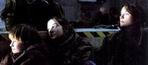
The Laurent family drive up to their weekend cabin in the woods and begin to unpack their belongings from the car. However, when father Georges (Daniel Duval) and mother Anne (Isabelle Huppert) enter the home, they are confronted with a shotgun-wielding man and his family ordering them out at the top of their voices. Georges tries to calm the situation and asks what the man wants, and perhaps they could come to some kind of compromise? Just as he is telling him what supplies he has with him and how much fuel is left in the tank of the car, the gunman pulls the trigger and kills Georges. Now Anne and her two children, Ben (Lucas Biscombe) and Eva (Anaïs Demoustier) will have to fend for themselves because something has gone terribly wrong with the world...
Bearing that in mind, all the clues you get as to what exactly has happened are that the water is poisoned and there is no electricity working, anything else outlining the disaster writer and director Michael Haneke keeps resolutely to himself. It's as if the event that has plunged society into chaos doesn't matter so much as how it is coped with, or not, by the characters, as Haneke attempts to bring home to comfortable audiences what it would be like if all those disasters you hear about on the news were to actually occur to them. Although we are not given dates, the time is presumably the near future, and it takes almost half the film for the viewer to get their bearings.
After being shown the door by the cabin-stealing family, Anne and her children (and the pet budgie) must first find shelter, which they eventually do in a building in the nearby village where there is a huge bonfire of cows being held, but strangely hardly anyone else about. They eat and drink what supplies they have with them, and the next day Anne ventures out to find somewhere else for them to stay, somewhere safer. Oddly, Haneke doesn't follow her on her search, but stays with the kids as the budgie is accidentally set free and Ben suffers a nosebleed. Maybe Anne's adventures would have been too exciting.
The next night they spend in a barn, and the scenes of darkness are superbly shot by cinematographer Jürgen Jürges, with a seeming eternity of inky blackness lit by a solitary lighter or smouldering hay that do nothing to banish the gloom. Ben disappears into this night, and Anne and Eva search desperately for him until morning breaks. Then they are paid a visit by a nameless teenager (Hakim Taleb) who is holding Ben at knifepoint, and Anne has to talk him down and suggest that they can work together. This will be a recurrent theme, with the survivors either attacking each other due to their prejudice or suspicion, or making prickly moves to support each other.
Although the teenager leaves them to look after himself, something which has unforseen consequences, Anne, Ben and Eva follow the railway track on which trains can still occasionally be seen until they reach the station where they have heard that a group of people are starting a community of sorts. This turns out to be true up to a point, as the desperation means they still have loud rows with each other (Béatrice Dalle has her moment in the limelight during one of these) and food and clean water are much coveted and handed out frugally. They hope to stop the next train to secure travel, and so the film mopes on, fashioning an apocalypse as mundane as possible, only adding points of interest, like the bizarre superstitions of some characters, as cheeseparingly as the clean water they get to drink. It may strike at the heart of the complacent society it ruins, but Time of the Wolf inevitably and numbingly loses momentum - be honest, wouldn't you rather there was some Mad Max-style action here as well?