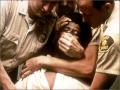
The time is the nineteen-seventies, the near future, and civil unrest is rife in the United States of America due to protests about the Vietnam War and perceived human rights abuses by the government. The result is that the authorities have set up a sentence known as Punishment Park for the civil disobedience criminals to undergo as the prisons are already overcrowded. Some documentary makers from the Western world have been allowed permission to film the trials and the sentence itself, where the accused can choose between years in jail or a three day ordeal where they must flee across the baking California deserts pursued by the police and National Guardsmen. This seems the easiest option...
Writer and director Peter Watkins, living in the U.S.A. during the earlier years of the Vietnam War, was patently inspired to make this film by the protests making the headlines throughout the country at the time. Specifically, the trials of the likes of Abbie Hoffman and Bobby Seale, which he had planned to dramatise until the shootings of students at Kent State University took place and Watkins decided to make a fictional work which would sum up the politics and social climate behind the news. This stark drama filmed under the unforgiving glare of the sun was what he came up with, but how successful in making clear both sides in the debate is questionable, if indeed that's what he intended.
The action moves between two "stories". First, a group of accused are brought before a court of senators and other influential people to answer for their crimes and basically choose between their penalties. This involves a lot of shouting and swearing on behalf of the defendants as they find that putting their points across is not unlike banging your head against a brick wall - and vice versa, as the officials can't put their views across to them either. This is all staged in a large tent at the border of the "Park", where, once their decision has been made, the insurgents will be carted off to the starting line to begin.
The second storyline follows a group who are already undergoing their sentence as they run and stumble through the searing heat towards, initially, the promise of water, then finally towards an American flag which marks the end of the ordeal. They gradually split up into factions, with some promoting violence as a way of fighting back against the approaching police and soldiers, and pacifistic others simply wishing to see out the three day tribulations and reach the flag. However, as we witness, the documentary makers have been filming the cops and the manner in which the officers brandish guns and rifles doesn't exactly look as if there will be a peaceful solution.
And of course, there isn't one. Watkins' use of handheld camera throughout gives the drama a genuine feeling of watching actual events unfolding, and the cast, made up of people who had never acted before and in many cases never acted again, are surprisingly convincing. This, despite some of the actors sharing the opinions of their characters and others being against them. But the whole thing is predictable, so it's no shock when the prisoners are killed off one by one, and the constant switching between yelling in the big tent and sweaty huffing and puffing out in the desert can't help but grow monotonous. One thing that is undeniably effective is the frustration of either side never being able to see eye to eye, although Watkins' sympathies are not in doubt by the end. An interesting snapshot of early seventies' social conflicts in the U.S.A., for all that, and not as hysterical as it might appear. Music by Paul Motian.
Critical, socially-conscious British filmmaker whose short films like Diary of an Unknown Soldier led to work at the BBC, making Culloden and The War Game, the latter proving so controversial that it was banned. He turned to cinema features with Privilege and Punishment Park, then went to Scandinavia to create incredibly long dramatic documentaries such as Edvard Munch.