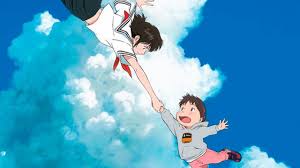
Four-year-old Kun (voiced by Moka Kamishiraishi) is unimpressed when his young parents bring home his new baby sister Mirai. Poor Mum (Kumiko Asou) and Dad (Gen Hoshino) already struggle balancing baby care with their demanding day jobs, but life gets that more stressful when an insecure Kun throws daily tantrums and, worse yet, lashes out at his sister. Then one day while stomping around the back garden Kun unexpectedly stumbles through a magical time portal. It brings Kun face to face with a feisty teenage Mirai (Haru Kuroki) who not only demands her "big" brother behave nicer towards her infant self but also help save their family's future.
Mamoru Hosoda, the groundbreaking anime auteur behind Belle (2021), Summer Wars (2009) and The Girl Who Leapt Through Time (2006), is fascinated with shifting dynamics in contemporary Japanese families. In the case of Mirai a sibling relationship flipped upside down thanks to time travel shenanigans. Many a child goes through the same feelings of anxiety as young Kun. That nagging sense they have been abruptly usurped by a younger, cuter sibling whose infant vulnerabilities exert a stronger grasp of their parents' attention. Kun’s bratty behaviour and inarticulate resentment are portrayed here with a level of psychological acuity and, perhaps more crucially, non-judgemental empathy that distinguish Mirai as an especially insightful, engaging slice-of-life fantasy. The main thrust of the narrative is that Kun's time-displaced encounters with not only teenaged Mirai but his mother as a child and grandfather as a cool young man grant him insights into their feelings. And so allow Kun to find a fresh place within a family dynamic altered by the arrival of his sister.
Those more accustomed to faster paced fantasies may find the setup too slow. Yet its defiantly earthbound domestic drama, tonally different but not far removed from the intro to Pixar's Up (2009), lays crucial groundwork for the film’s primary theme. Kun might be the chief protagonist and Mirai more a catalyst than a character but this is really a story about a family muddling through daily dramas as best as they can. True to form Hosoda observes the shift in domestic life in modern Japan as a hapless stay-at-home dad finds he is out of his depth while mom navigates a complex mix of resentment and guilt. Remarkably for an animated film aimed at family audiences Mirai does not sugar coat tensions between couples raising children nor their tendency to lash out at each other. Even so the story ultimately evolves into a loving portrait of family with poignant musings about the cyclical nature of parenthood and childhood. Admittedly the episodic narrative could almost be a series of YouTube shorts but be patient. The story eventually coalesces into an astonishing fantastical third act that transforms Kun's childhood anxieties and identity crisis into a full blown existential nightmare. This in turn segues into a mind-blowing and genuinely moving cosmic odyssey through Kun and Mirai's family’s entire lifespan. Akin to, believe it or not, a more upbeat, family friendly anime version of Gaspar Noe's similarly metaphysical Enter the Void (2009). I'm not joking. Incidentally Tatsuro Yamashita's jaunty opening and closing themes are seriously infectious J-pop bops.