On New Year's Eve famed manga artist Osamu Tezuka (voiced by Kyoji Kobayashi) leaves his latest work behind to visit a grand mansion. There a host of Tezuka's most celebrated characters gather to celebrate the new millennium and throw their creator a surprise party. Naturally Atom a.k.a. Astro Boy (Mari Shimizu) is there along with Sapphire (Yumi Touma), star of Princess Knight, Sharaku (Motoko Kumai) the Three-Eyed One, his gal pal Chiyoko Wato (Naoko Matsui) and scientists Dr. Ochanomizu (Hisashi Katsuta) and Dr. Tenma (Tamio Ohki). Late to arrive are badass surgical genius Black Jack (Hiroshi Otake) and kid sidekick Pinoko (Yuko Mizutani) whom immediately clashes with stuffy robot butler Robita (Hiroshi Otake) and harangues Tezuka as to why she and Black Jack are not yet married! In the midst of festivities a troubled Tezuka confides in Atom he has been followed all day by a mysterious stranger. Then after a stranger electromagnetic pulse disrupts the mansion Tezuka vanishes without a trace! It falls to his manga creations to find out what happened.
By the time this meta-textual anime special aired on December 25, 2000 the real Osamu Tezuka had been sadly deceased for more than a decade. Created to mark not only Tezuka's passing but the anniversary of the television network that aired many of his great works and also of course the dawn of a new century, Osamu Tezuka's Last Mystery of the 20th Century is a charmingly eccentric oddity. What could have been trite and gimmicky instead proves engrossing and, in its latter stages, a genuinely moving tribute to a true giant of Japanese manga and anime. In a manner reminiscent of Marine Express (1978), Last Mystery fashions a crossover featuring many of Tezuka's most beloved creations alongside a fictionalized version of the great man himself. Not for the first time either. The real Tezuka routinely made cameos in his own manga and animated works. Including a prominent supporting role in the live action/anime hybrid Vampire (1968) that, despite its title, actually concerns werewolves.
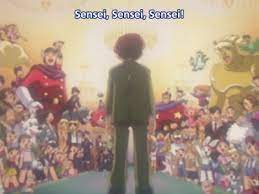
Essentially an Agatha Christie-like parlour room mystery (Christie was among Tezuka's many notable literary influences) the plot throws plenty of intrigue, red herrings and twists. By comparison the animation is somewhat uninspired. While certainly adequate it lacks that distinctive off-kilter inventiveness and cinematic bravura that distinguish Tezuka's own anime classics. Nevertheless the animators ensure that the characters remain authentic and engaging. Also that the plot, as it gradually evolves, reflects more of Tezuka's humanitarian themes and ecological concerns. Some find the messages herein a tad preachy. Yet one could argue they encompass the author's lifelong Buddhist-influenced ideals both authentically and eloquently. For Tezuka fans the finale wherein around a hundred classic characters pay tribute to their creator will likely provoke a sniffle or two. Especially when one key character, wholly appropriate on a thematic and personal level to the late manga genius, arrives to guide him on one last cosmic adventure.