For Kikue Amayima (Kin Sugai) it was just another ordinary day, her husband had been in Tokyo having a medical check-up, a routine one that he had every year and it had gone very well as he had been given the all-clear. To celebrate, he bought a special meal home and ate it that night, telling his wife his greatest desire would be to pay a young woman of about twenty to listen to his war stories since Kikue was not interested anymore, if indeed she ever was. She tells him he is an old fool, and nobody would take that post, then bustles off to wash the dishes. However, as he contemplates his repast, he collapses...
Lots of ironic humour in this comedy from actor turned director Jûzô Itami, who was inspired to become a screenwriter and director (though not star) by the experiences of his actress wife at the actual funeral of her father. She was Nobuko Miyamoto, and they would go on to collaborate again over a course of a few years; Itami certainly became more celebrated in the West for his direction than his acting, Tampopo, his next film in that capacity, being his most famous. In fact, he was most celebrated in Japan for his commercials, which were frequently ingenious, and he created an example here as if he was unsure of his audience.
Indeed, while there was much here to appeal to the Japanese sense of humour, the problem may have been in travelling in the West as a lot of it was very specific to their culture and what could have landed with belly laughs in the Far East was in danger of resulting in stony faces had it played on the other side of the world. The sort of jokes that Japanese media makes that can appeal to the Westerners are the wacky stuff, and though things got fairly weird in places here, it was not really that kind of a comedy, preferring deadpan observations on the customs around the Japanese funeral business, though some have described it as a sex comedy.
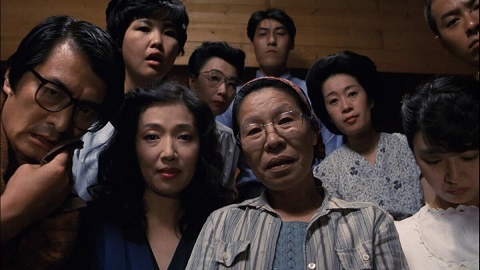
Purely because there was a sex scene in it which the deceased's son-in-law Wabisuke (Tsutomu Yamazaki) was forced to have intercourse with a woman who was not his wife, to calm her down. And this in the forests around his late father-in-law's rural retreat, something that might have been amusing to the Japanese but simply looked offputting to the eyes of foreigners. Fair enough, there was not a whole lot of sequences like that one, and most of this was a comedy of manners as we see the funeral arrangements drag on through three days to nobody's satisfaction, with guests at the wake who are irksomely reluctant to leave, or traditions that are more tied to commerce than respect.
One of the odd things about the late father-in-law is that from what we see and hear there is no evidence he was a particularly great guy, and may not be worthy of all this attention, another example of the dubiousness of these customs. We hear he used to run a brothel and helped himself to the talent he rented, all in full view of his wife, which has you pondering why she stuck by him for so long: it is Kikue we feel truly sorry for, and her heartfelt speech at the end seems more poignant for her since her husband just was not worthy of her. The film takes a strange kind of revenge on him for his callousness by having his corpse, if not desecrated, then not exactly treated with respect throughout the episodic story, culminating in a sequence where the little kids gawp at the body being cremated with morbid fascination through a special window in the chamber. If you can adjust to it, The Funeral may not be as accessible as some Japanese cinema, but it is sharply observed. Music by Joji Yuasa.
[The Funeral is available on The Criterion Collection, a Blu-ray with the following features:
High-definition restoration, with uncompressed monaural soundtrack on the Blu-ray
New interviews with actors Nobuko Miyamoto and Manpei Ikeuchi
Creative Marriages: Juzo Itami & Nobuko Miyamoto, a short program produced by the Criterion Channel
Commercials for Ichiroku Tart by director Juzo Itami
Trailers
New English subtitle translation
PLUS: An essay by author Pico Iyer and, for the Blu-ray, excerpts from Itami's 1985 book Diary of "The Funeral" and from a 2007 remembrance of Itami by actor Tsutomu Yamazaki]