Once upon a time, Belle (Josette Day) was the servant of her two cruel, older sisters now that their father (Marcel André) had lost most of his money and had to let their staff go. Today the sisters, Felicie (Mira Parély) and Adelaide (Nane Germon) are going to a meeting in the high society they feel they are born into, but all the while their brother Ludovic (Michel Auclair) makes fun of their pretentions. Meanwhile, their father decides to take a business trip to change their fortunes but gets lost in the misty forest until he wanders towards a sprawling castle - an enchanted castle, as he soon discovers...
The folk tale of Beauty and the Beast is a well known one from childhood, and it's that childlike sense of wonder that the writer and director, poet Jean Cocteau, aims to recreate in this exquisitely designed version. An important film in French cinema history, arriving as it did just after the Second World War, perhaps Cocteau thought it was just the tonic to take the audiences' minds off the near-overwhelming tragedies of the conflict, and it does, for its ninety minutes or so running time, transport you to another world of magic and mystery, even if the outcome of the story may be overfamiliar. Especially if you only know the Disney version.
After introducing the family and Ludovic's friend Avenant (Jean Marais) who loves Belle but has his marriage proposal turned down because she's devoted to her parent, the film settles down into rich fantasy with the arrival of the father at the castle. First his horse is held behind self-closing doors in the castle stable, then he ventures beyond the front doors down a hallway lit by candelabra held by human hands emerging from the walls. The dining table he sits at is obviously not self-service because the wine is poured by an ornament as he is watched by the statues adorning the fireplace. The atmosphere of the bizarrely picturesque is expertly sustained.
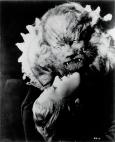
All is going well for the father - he has food and shelter, even if he does lose his horse - but he has to pluck a rose from the garden to take back to Belle, doesn't he? All of a sudden the Beast (also played by Jean Marais, far more imposing in this role with his fiercely soulful eyes visible through the makeup) appears and tells him he is now cursed and must die for removing the flower, but the father pleads for his life and the Beast shows mercy, telling him that either he returns in three days or he sends someone in his place. Belle, of course, goes and the central love story takes shape with the lonely yet hopelessly animalistic Beast trying his best to impress her with his magic, but Belle initially too terrified and repulsed by his appearance and mannerisms to accept his advances.
The tale is presented so purely that a great number of themes can be read into it, like all great fables, but the prevailing one seems to be not so much that love conquers all, more that if you look beneath the surface the most unlikely people not only can be loved, but can be capable of great love even if it is not reciprocated. The sweet thing about the swooningly romantic La Belle et La Bête is obviously that the love is eventually given back, but it's also the film's downfall. The grand finale is nothing but a grand letdown, with the Beast transformed from the dashing feline who was glad of Belle treating him like a loyal puppy, into the form of Marais, which considering he played the morally dubious Avenant as well, means you much prefer him in his fanged incarnation. Still, for the most part the film is impressively strange and beautiful. Music by Georges Auric.