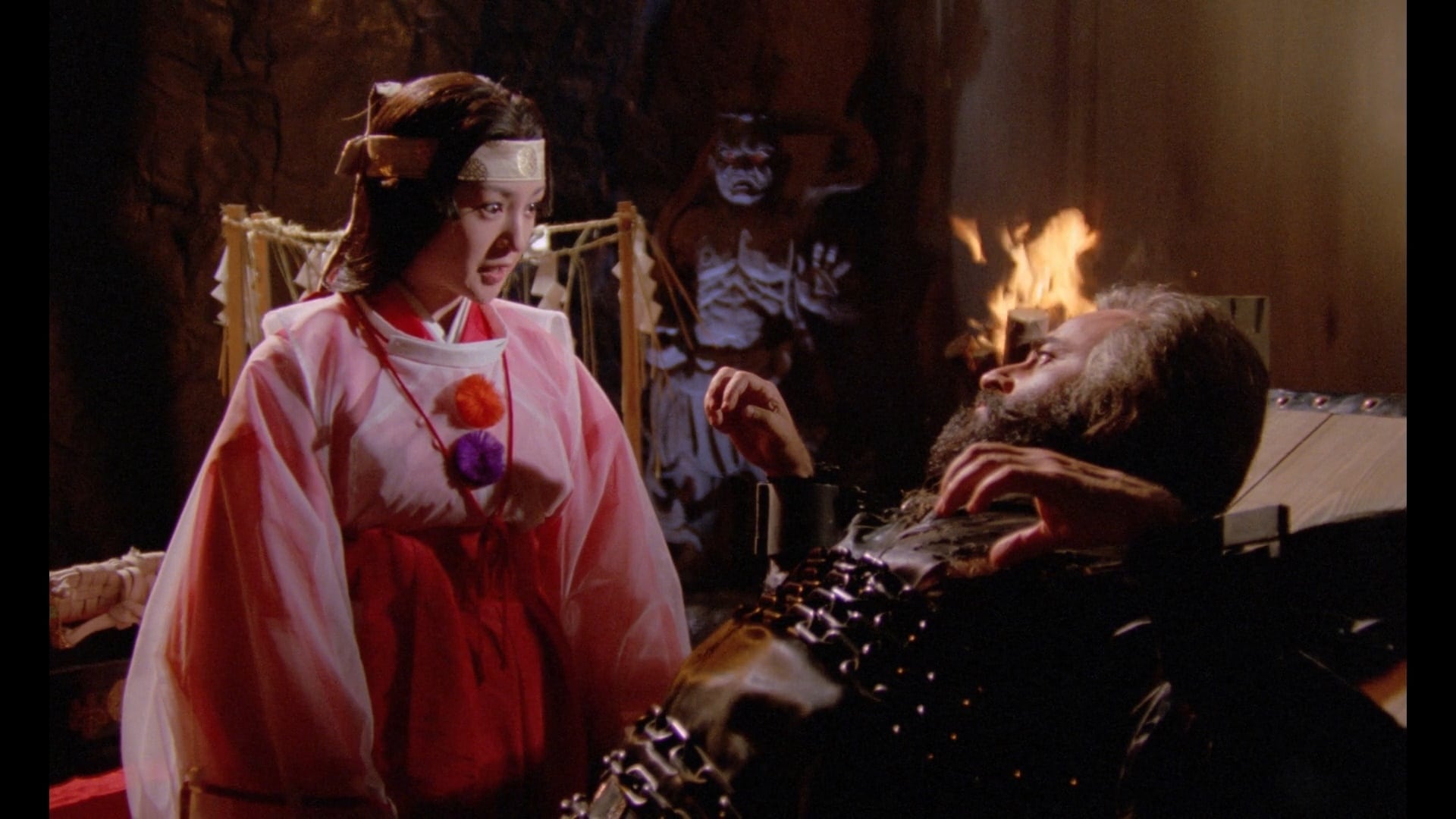
The so-called Full Moon Killer is on the loose in Sixteenth century Japan, slaughtering entire villages. Tasked by the Shogun samurai and medical expert Kian (Shigeru Amachi) is out to end the killer's bloody rampage. Meanwhile, and not coincidentally, Polish nobleman Waldemar Daninsky (Paul Naschy) arrives together with his devoted wife Kinga (Beatriz Escudero) and similarly smitten blind psychic gal pal Esther (Violeta Cela) desperately seeking a cure for the ancestral curse that by full moon-s light transforms him into - madre de dios! - El Hombre Lobo!! Sympathetic to the tormented Daninsky's plight, Kian enlists the aid of his saintly sister Akane (Yoko Fuji) in researching an herbal remedy. When their efforts fail, Kinga turns to the magical might of the mysterious Lady Satomi (Junko Asahina) unaware that she plans to use the werewolf for her own evil ends.
In the early 1980s a Japanese television network commissioned actor-director-Euro-horror icon Paul Naschy, a.k.a. Jacinto Molina, to make a series of travel documentaries about his native Spain. Evidently these proved successful enough Naschy was able to convince them to co-finance his tenth outing as werewolf Waldemar Daninsky, bouncing back from the commercial failure of his last effort, the otherwise critically lauded Night of the Wolf Man a.k.a. Return of the Wolf Man a.k.a. The Craving (1980). By this point in time Naschy's sincere, unironic, lyrical approach to gothic horror was seemingly out of step with the tastes of genre devotees. It is worth noting however that few of Naschy's films ever reflect the state of contemporary horror. As the prologue makes clear (describing the story as taking place in "distant times when all fantasy was possible") his movies exist in a nebulous Neverland merging the gothic romanticism of old Universal monster movies, Silver Age comic book tropes and the freewheeling sexuality of the Sixties and Seventies counterculture. To all of this La Bestia y la Espada Magica (The Beast with the Magic Sword) adds elements of Japanese period horror with sequences that riff on the likes of Kwaidan (1964), Onibaba (1964) and The Ghost of Yotsuya (1959) whose star Shigeru Amachi both co-headlines and co-produces here.
Talky and plodding, at least for its first two acts, The Beast and the Magic Sword more often than not resembles one of the 'taiga dramas'; historical serials popular on Japanese television at the time. It also wastes time getting to the point, indulging in two separate prologues (including an origin story where Naschy plays his own ancestor) before we even get to Japan. Typical for a Naschy production the film counterbalances an eloquent, albeit at times florid screenplay rife with intricate historical detail and carefully-conceived supernatural lore with trashy exploitation elements. While the werewolf dispatches male victims swiftly enough he makes sure to disrobe all the ladies, allowing the audience a gratuitous eyeful before bursts of gore. The writer-director-star also allows himself not one but three love interests as in addition to, er, his wife Kinga, both Esther and Akane fall hopelessly for the wolf man, despite Daninsky charitably possessing all the charisma of a whelk. We never really come to understand why all these seemingly strong, capable women are so devoted to a blank-faced clod like Waldemar when all it seems to earn them is a swift death. Even so the film upholds a longstanding tradition in the Daninsky films wherein the werewolf can only be slain by a woman that truly loves him. Or in this instance a woman that truly loves him in possession of a cool magic samurai sword.
Naschy, whose werewolf makeup here is serviceable but not among his best, claws his way through proceedings with amiable relish but away from lycanthropic antics proves stoic to the point of somnambulant. Shigeru Amachi, while similarly one-note has a slow-burning charisma that proves more persuasive. Naschy the director wisely lands Amachi with all the cool action scenes including a fight at a hot springs resort where he takes on an array of assassins including the token topless lady ninja. The Beast with the Magic Sword only truly takes flight in its latter third. Here Naschy's direction shines staging a hallucinatory sequence set inside a lake of fire and pitting Amachi's sword-wielding hero against zombie samurai, witches and a cackling red-haired ogre before ultimately going mano-a-mano with the wolf man himself. Waldemar Daninsky would return... thirteen years later in Lycantropus (1996).