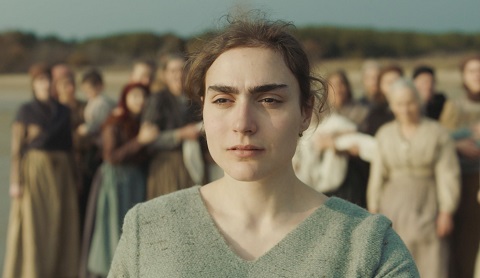
Agata (Celeste Cescutti) is a woman of rural Italy in 1900, where Christianity in a form that even then trades in arcane rituals and beliefs that seem paganistic to modern eyes is practiced. This would be fine with her until tragedy strikes: she has been pregnant for the past nine months and is expecting to give birth and start her life as a mother, but in the process of the birth something goes wrong and the infant dies. Then, to add insult to injury, she is informed by the local priest that he cannot baptise the mite because it never took a breath, therefore according to their beliefs her soul will remain in limbo for all eternity, never washed clean of original sin or able to enter the kingdom of heaven...
Agata is not having that, so when she hears of a place where stillborn babies can be revived for one breath and baptised as a result, she makes up her mind to go there with no qualms about undertaking the long journey so soon after her medical emergency. And there, if you did not have enough problems with the religious themes, you may start having problems with the good sense of the characters. Agata does not, say, take a horse and cart to this possibly mythical location, nope, she goes on foot, carrying the tiny coffin of her child on her back, and something akin to the tales of the old saints in its spiritual austerity and behaviour that can only be interpreted through the most deeply religious actions imaginable.
The result of that is that our heroine comes across like a bit of a maniac, so fixated on delivering her dead baby to the magical land that she neglects utterly any self-preservation. Director and writer Laura Samani at least acknowledged this in her debut here, and halfway through Agata notices that she is beginning to bleed very heavily as the journey is simply too much for her; plus, you cannot help but note she is going through this physical and mental torture because men have drummed these beliefs into her. Is it significant to the film that the concept of limbo was discarded by the Church as hopelessly outdated some decades after the setting of this story? It probably is, given if it had never been invented, we would not be seeing this young woman endure sheer hell and all because some blokes in funny hats made her already trying life even more of a misery.
Small Body, or Piccolo Corpo in its original Italian, was essentially a road movie, as gruelling an excursion for Agata as the one in the Lord of the Rings trilogy was for the Hobbits. She does get her own Hobbit-y companion in Lince (Ondina Quadri) who accompanies her for the greater part of the journey and indicates the movie has at least some modern sensibility in that he is a girl who was ostracised for wanting to live as a boy, and Quadri was a trans performer, which might have been something considered by someone like Federico Fellini or Pier Paolo Pasolini in the progressive Italian cinema of their heyday. So that was a neat callback to the boundary pushing that went on in Samani's nation's cinema, but the fact remained this was a troubling work when in the final scenes Agata's great sacrifice for what may well have been spurious reasons were decided to be wholly (and holy) justified, which would have you considering whose side the director was supposed to be on. The impression it gave was of wanting to be uplifting and moving, what it actually was turned out to be ill-judged and concerning. With nice scenery. Music by Fredrika Stahl.