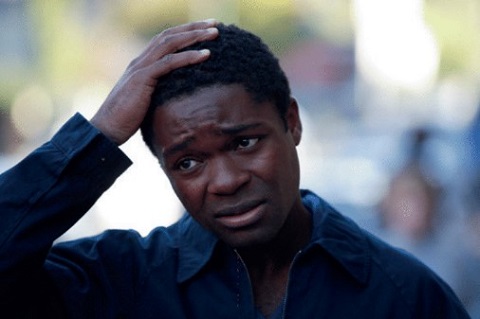
Joseph Pascale (David Oyelowo) has a confession to make: he hates black people. As a black person himself, you can understand this places him in a very difficult position, but he has worked out that every single bad thing that has happened to him in his life is because of black people, and frankly, it is getting to him. The real troubles started when he went to a public meeting to hear that male, black teachers for black pupils were far too few in number, so feeling like a man with a mission, he signed up for the qualifications, leaving his computer programming behind, and began teaching with a stern remit in mind...
One of the most controversial television plays ever broadcast by the BBC, it was a hark back to the days of Play for Today in the nineteen-seventies when one of their programmes could be a national talking point. But the accusations of racism that writer Sharon Foster and director Ngozi Onwurah faced were curious, given they were women of colour themselves: were they telling it like it was or were they pandering to white-led stereotypes of their race and doing more harm than good? It appeared nobody could decide, and after the dust settled, Shoot the Messenger faded into the background, either ignored or forgotten.
By many, but it contrived to be a play that was tough to forget completely, which is why it is instructive to return to it all these years later and assess it afresh. It would be the last screenplay Foster would have produced, it is difficult to find much information about her other than a couple of articles she wrote at the time justifying the showing, but it appears she passed away some time ago. Considering this was an award-winning script and looked heavy with the promise of so much more to come, if you were at all touched by Shoot the Messenger you would find yourself with a sense of loss that she never had a chance to follow this up.
Aside from being an early credit for a wealth of black British talent (you can spot Daniel Kaluuya or David Gyasi there, among others), it was the perspective Foster brought to what she described as a black Alfie (Oyelowo regularly speaks to the camera throughout) that really electrified the piece. It is important to know that Joseph is not necessarily a sympathetic character, and if he were a white character what he says would be unacceptable. But is it unacceptable as a black character? That was the crux of the criticism, that accusation he was speaking opinions that would be fuel to racism, but there was an obvious attempt here to use the language of outrage and shock to make its impact. It had no special effects, nothing but the dialogue and acting to keep you watching, and it did.
In truth, looking at the play now you could say Foster had too much on her plate as if she knew this was her last chance to say what she wanted on a large stage and had to make every scene, every point, count. Joseph decides black people have ruined his life and that becomes a self-fulfilling prophecy as his actions get him in hot water, never once occurring to him that he may be partly responsible. Responsibility was the major theme: Foster wanted to illustrate how her race in Britain and abroad refuse to accept where they are getting it wrong in their community and blaming the whites for everything negative. She wasn't saying the whites were not a factor, just that her community should not embrace the blame culture that holds so many back. When Joseph is falsely convicted of attacking a pupil, it sends him into madness and rage, not realising it is members of the black community who are trying to help him out of it. Maybe that was it: Foster was trying to help, and it backfired. But watch Shoot the Messenger now, and you perceive those positive intentions.
[The BFI release this on Blu-ray with the following special features:
Presented in High Definition
Three short films by Ngozi Onwurah: The Body Beautiful (1990, 24 mins): an examination of the real-life relationship between the director and her mother, Madge; Flight of the Swan (1992, 12 mins): a young girl leaves her Nigerian village for the cold, harsh landscape of England and White Men are Cracking Up (1994, 20 mins); traces the last day in the life of a white detective, obsessed with a Black 'street goddess'
Who We Are: Filmmaker Forum with Akua Gyamfi, Fiona Lamptey, Stella Nwimo and Delia Rene (2020, 66 mins): four women creatives explore Black British film in a series curated by We Are Parable
Illustrated booklet with new writing by Anglea Moneka, co-founder of the T A P E collective, Dwain Brandy, Ann Ogidi, Jan Asante and the BFI's Grace Barber-Plentie
English subtitles for the deaf and partial hearing available on all three short films.]