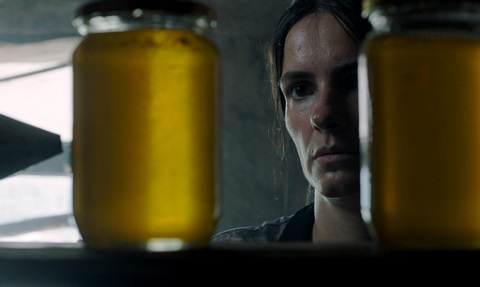
For Fahrije (Yllka Gashi), life has never been the same since her husband went missing. She lives in Kosova where the Serbian soldiers have been slaughtering the men of the villages they invade, and her husband may have been one of the victims, but cruelly, she does not know for sure and is seeking to find out, though hope is fading with every day that goes by. She lives in a village keeping up his beekeeping business, but the honey is not paying their bills and she has no real knack for the practice, frankly, she keeps getting stung. She must find a method of supporting her family - two growing children and her wheelchair user father-in-law - when her husband's fate is so uncertain, but the ultra-conservative men in the region have other ideas...
Yet another film to make men ashamed of their gender, Hive had the integrity of not being some swipe at everyday sexism but a story that was based in truth, as Fahrije is a real woman, and she runs a business out of Kosova. Not only that, but she was subjected to the kind of prejudice from men that we see here, and though a disclaimer at the end is featured to state some of what we witness in the film was fictionalised, the gist of the piece was the truth: she was victimised quite severely for setting up her own condiments company, employees the war widows of her village. There was a danger here of going the self-empowerment route with the tale, but director Blerta Basholli sustained a mood of suppression for her characters that was oppressive.
There was no one male who led the protest by bullying against Fahrije, it seemed to be the whole village of men in one homogenous mass were utterly obnoxious in their ingrained sexism, as this was the norm, this was what they had been brought up to believe. Somewhere here was a theme of how much work had to be done to change reactionary attitudes, and while there were plenty of films that tackled this subject, you did wonder if they were preaching to the choir since you could not imagine some died in the wool misogynist settling down to watch this, probably because of how uncomfortable it would make them. And also, Basholli used a somewhat austere style to keep her telling grounded in as much authenticity as she could, which meant it could be accused of being worthy, though think of the alternatives and you would have to say she made the right decision.
Nevertheless, though we see tiny clips of documentary footage of the actual Fahrije just before the end credits, they seem a world away from the basic and insular world we are offered in the rest of the film, and you can't help but wonder how she got there from here. Better to regard this as an origin story, not of a superhero but someone who broke the mould and made the best of a post-war landscape that had done so much damage, and resort to be inspiring that way. It was a low-key film for the most part, with the characters preferring to simmer with resentment or be cowed by fear of consequences of breaking with conventions than actually take action, which made it feel even more threatening when the men take their persecution to a different level, smashing things up or even in one instance an attempted rape to put the protagonist in her place (it doesn't work). Not that enjoyable to watch, then, but you did feel as if you had been improved by being made aware of this account, and Gashi's well-balanced, restrained performance centred the drama and gave us a focus for our sense of the injustice meted out to her. Music by Julien Painot.