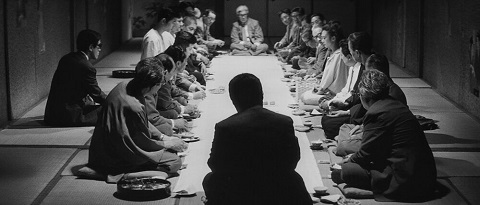
Muraki (Ryo Ikebe) has just been released from prison, after serving a three-year sentence for murdering a gangster as part of a gangland hit. But things don't seem to have changed very much since he has been inside, nobody looks to have progressed any, and he believes he can slot back into his old ways fairly easily. Those old ways include attending illegal gambling dens, where he can simply watch and soak up the atmosphere, or can participate - he doesn't really care whether he wins or loses, he just likes to be there. It is almost entirely men who gamble, so the presence of a woman intrigues him...
We were film noir territory for Pale Flower, directed by Masahiro Shinoda and a big success for him in his native Japan; abroad it became a cult movie among those who like the cinema of that nation, since it seemed to speak to something in the Japanese spirit, especially as it was feeling as the nineteen-sixties drew on and a dissatisfaction with how things had ended up after the Second World War grew more plain. Some were on the right, and believed Japan had been hard done by for their war crimes, while others were on the left and ashamed of the recent past, and angry it had taken them to this limbo state.
Therefore in Pale Flower there was a clear sense of the country's feelings, and in the character of Muraki a sense of one individual who has become trapped in a modern world that has reached stagnation, a kind of stasis that something dramatic will have to show up to shake him out of it. Could this gambling woman, Saeko (Mariko Kaga), be that catalyst? He knows nothing about her, and he is a few years older than her, but she holds an allure merely by her presence in among the gamblers and she is apparently attracted to him as well. He naively thinks this is down to her being an innocent in this underworld and in need of protection.
Well, Muraki doesn't know the world has changed after all while he's been out of it, and as he tries to get back his old status in the gang he used to belong to, like a business drama he finds himself in a set of negotiations and mergers that go way over his head. This means he has whatever anyone else has in this landscape: the utter dejection that hope has left long ago, and we will all have to muddle through either until we are rescued or, more likely, that fate will close in and see to our conclusion that way. Our hero believes Saeko could be his saviour - he already has a girlfriend who waited for him, but weirdly, she kind of revolts him for being so loyal to someone (himself) he fails to think is truly worthy of being waited for.
Meanwhile there is an assassination to be taken care of, and since the hitman will almost surely go to prison for the crime, Muraki puts himself forward as a prime candidate, for he has not liked what he sees now he is back as a free man. The irony being, he was never free, he is constrained by this wandering between gambling dens, racetracks, drinking holes and back in his own bed, alone, so he might as well be in jail for all the good society is doing him. As you may expect from this genre, Saeko is our femme fatale, yet Muraki was doomed well before he met her, and she is on her path to her own personal hell; you think you've seen a nihilistic movie before, but many of them have nothing on the utterly hopeless set of circumstances laid out in Pale Flower. For that reason, it's not going to be a universal favourite, but Shinoda's technique was supremely stylish, on that many will agree even if they find the results unpalatable. Remarkable music by Yuji Takahashi and Toru Takemitsu.
[The Criterion Collection release Pale Flower on Blu-ray with these features:
New high-definition digital restoration, with uncompressed monaural soundtrack on the Blu-ray edition
New video interview with director Masahiro Shinoda
Selected-scene audio commentary by film scholar Peter Grilli, coproducer of Music for the Movies: Toru Takemitsu
Original theatrical trailer
New and improved English subtitle translation
PLUS: A new essay by film critic Chuck Stephens
New cover by Michael Boland.]