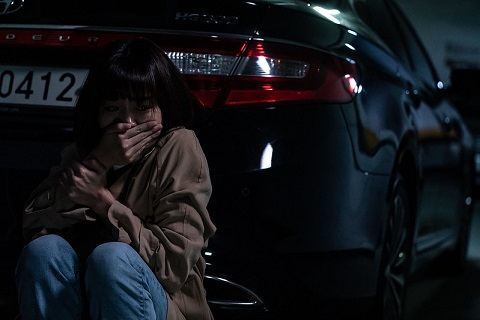
A woman has just missed the last taxi home in this built-up area, and is forced to start walking homewards as she calls someone who would be good enough to give her a lift, but as she does so, a man pulls up in a 4x4 and asks her if he can help instead. She knows better than to do that, so turns him down, somewhat abruptly but firmly, and walks on, but as she secures her lift she notices the man in the car is hanging around and her suspicions are raised. Rightly so, as she is attacked and dragged inside, struggling all the while. Later, the murderer calls the police and toys with them, pretending to have found her body...
That is because Midnight was largely about plausible liars, and the blind spots in society they can use to their advantage. Though a slightly cartoonish figure in the context of the story, Wi Ha-Joon as Do-Sik, our villain, was so despicably evil that whatever writer and director Kwon Oh-Seung tried succeeded admirably: we really, really want to see this man brought down, and when nothing happens to halt him in his tracks, and indeed the world around him positively encourages his lies and victimisation, a creeping despair is tangible. Thus we genuinely need to see Do-Sik thoroughly foiled, and not merely because it satisfies our sense of justice.
But because it satisfies our need to be reassured the evildoers in the world get what's coming to them, even when the world tends not to back that up to the degree we would prefer. One assumes Do-Sik sleeps like a baby after a night of mayhem, murdering people and making shit up to run rings around the cops while he gets away scot free. This is where the heroine Kyung-mi (Jin Ki-joo) enters the plot, as she has two disadvantages as far as the film can see: we like to think we are a good judge of character, but do we tend to believe men over women? And do we believe the able-bodied over the disabled? Kyung-mi is both a woman and deaf, and therefore not taken seriously.
In a way, this film had a similar problem, it could have been regarded as a schlocky thriller with horror overtones and dismissed as such, but it featured a sincere observation on how we treat those traditionally seen as "hysterical" or "over-reacting" when in fact there were serious reasons for their distress or even simple concern. Kyung-mi has been out on an office night out which she has not enjoyed because the boss's clients have been so obnoxious, but scored a small victory by insulting them to their faces with Korean Sign Language. The time comes to go home, so she has arranged to meet her mother, also deaf, but as she walks the street who should also be there but Do-Sik, who has spied a victim. Now he has two to choose from.
Actually, he doesn't choose, he picks them both, stabbing the first woman and stuffing her into his spacious car, then going after Kyung-mi. What follows was an ingenious cat and mouse that could easily be ignored as yet another woman in peril flick, but Kwon had more on his mind than that, and the injustice of the situation as the baddie is consistently believed over the female victims created a real tension that did not let up until the final minute as the credits loomed. Although not deaf herself, Jin was excellent in her role as a character you would often hear described as plucky or feisty, when in fact she was scared and resourceful in combination, and Wi was a formidable presence as he lies through his teeth to get his way, which he is allowed to do because almost everyone accepts those untruths at face value. Yes, it was a thriller foremost, but if it did any good, it would make you consider before taking the side of the powerful against the powerless. And the use of vulnerability as a weapon was a true crowdpleasing moment.
[Eureka's Montage release this on Blu-ray with these features:
Limited Edition silver laminate O Card slipcase (First Print Run of 2000 Copies only) featuring new artwork by Grégory Sacré (Gokaiju) | 1080p presentation on Blu-ray | Optional English subtitles | Brand new audio commentary by film historian Kat Ellinger | Brand new video essay on the history of Korean horror cinema by critic Travis Crawford | PLUS: Limited Edition Collector's Booklet featuring new writing by author and critic Alexandra Heller-Nicholas (First Print Run of 2000 Copies only).]