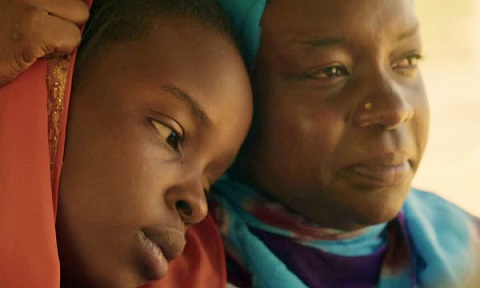
Amina (Achouackh Akabar Souleymane) is a single mother in Chad, a deeply conservative country embedded in its religious ways that inform its day to day life: attendance in mosques, for instance is more or less compulsory. And the local Imam believes it is all the more important for her, thanks to her family status, her actual family as well as her teenage daughter's family having abandoned her long before, so he believes she needs to be spiritually saved by his teachings. However, Amina has other things to worry about, like her profession of making stoves out of the wire from tires, a technique her friend knows about, and they make their money that way. Yet while her existence can be tough, it's about to get tougher...
This is down to Maria (Rihane Khalil Alio) becoming pregnant as her mother did, out of wedlock, and causing her to be thrown out of school by her stern principal who does not allow such supposed moral laxity in her establishment of learning. That more or less scuppers Maria's future, unless she can find a way out of his set of circumstances, and that means one thing: getting an abortion. Of course, the patriarchy has banned such a practice in Chad, so the initially horrified Amina, who comes round to her daughter's way of thinking after she attempts suicide by walking into a river, decides she needs to go by underhand means and secure the termination on the black market, if that's not a crude way of putting such an operation.
There was more to this as director Mahamat Saleh-Haroun built up a picture of religious and social hypocrisy, where when a woman has a real problem other people simply turn away, especially if that problem is gender specific. The Imam overbearingly offers to listen to Amina's woes, but she knows he will turn that around to weaponise against her, and besides, in her experience piety is a mask for some pretty unpleasant and reactionary views. She has seen it in her family who disowned her once she had Maria, and she is seeing it happen all over again with the girl - even Amina had an impulse to reject her when she was suffering, and now she feels ashamed of that. Her "boss" is keen to make an honest woman of Amina, but she doubts those intentions as well, believing him to only be after one thing, and it's not a homemaker.
But there's a shock lurking there which may be guessable and altered the course of the previously slow paced drama by turning it into a thriller of sorts, which did not quite fit in with what we had seen before. What did fit in was Amina's sister trying to reconcile, though she has an ulterior motive in that her daughter is being threatened with female genital mutilation by her husband, the girl's father, who like too many men in Africa is very keen on the idea. Our heroine is dubious at first, but then sees she can indeed assist by performing an act of subterfuge that closes out the film on an emotional high, yet we are always aware millions of other little girls will not be so lucky, and neither will others with unwanted pregnancies. So it was a very socially aware piece, very much standing with the sisterhood and a plea to the men in Chad society to change their way of thinking by placing them in the shoes of their community's victims. Whether it would succeed or not was a moot point, the fact of trying was laudable, and if Saleh-Haroun had a little too much on his plate here, it was a very decent attempt. Music by Wasis Diop.