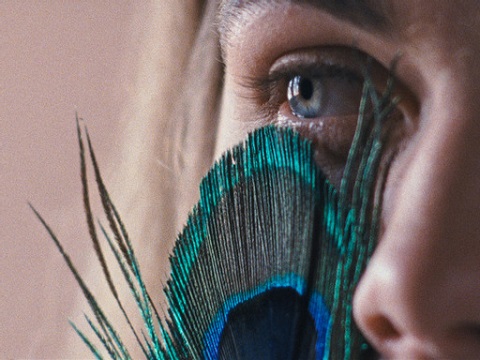
Henrique looks back on his life now he has been relegated to a care home in his old age, and wishes he still had his beloved wife Beatriz with him, or Triz as he used to call her affectionately. Alas, she died of a stroke back in the nineteen-eighties and he has been without her ever since, turning over his regrets in his mind, including giving her six children to bring up but never really being there to help her. This was because he was a sailor and was away at sea on a ship for most of his offspring's childhoods, and though Triz never really complained and loved him and her kids equally, it is apparent that the situation was rather unfair on her. Now, her daughter Catarina remembers her as well, less well her father...
We were immersed in the arthouse for this quasi-documentary from Portuguese writer and director Catarina Vasconcelos, which was fictionalised in places in a Werner Herzog manner to reach some ecstatic truth, though given the ample musings on display here, you might question the use of that impulse. Essentially this was a series of pretty pictures overlaid with a variety of voices making observations on the nature of family and especially motherhood, which was presented as not only the cornerstone of the unit, but of entire societies as well. Although the director tried to sustain a remote distance from her thesis to make it sound all the more considered and thoughtful, a certain sentimentality crept into her narratives as well.
Take the shot where a photograph of the director being born was developed before the audience’s eyes like a Polaroid snap, an image full of her mother's joy, but such a private, static visual scene that it felt we were being invasive by agreeing to watch it as Vasconcelos muttered away on the soundtrack. The rest of it largely preferred to be metaphorical, with the imagery of nature to match, as well as the imagery of people interacting with nature, from a dead bird receiving a respectful burial to hands snapping off leaves from trees, which were played backwards so it would look as if the plants were being restored. Nevertheless, you could not ignore that for the sake of a striking shot, there were acts of casual destruction going on to secure them, and in the latter stages stuff was being set on fire, to boot.
The impression was that you brought to this what you wanted, and if it struck you as pretentious babble that yawned on for over an hour and a half, then you were of course not going to get as much out of it as someone who was truly invested in Vasconcelos's narration and the pictures to go with them. Indeed, this was clearly part of the influence of social media on filmmaking, as while you could not imagine a blockbuster taking its approach, it did resemble scrolling down someone's account which they had stuffed with personal items and attempts at being arty to ensure a huge amount of Likes, rather than an actual, proper movie. Every so often there would be an arresting image, such as a lone figure at a cliff carrying aloft an unfurled flag of the subject's mother's face, or a twig that has had its tiny leaves encased in ice, turned over in a hot little hand, and you could see this was worth it. But there was too much that failed to find the universal in the personal, and then there were all those distancing effects: what reaction did she want from this, anyway? Music by Madalena Palmeirim.
[NEW WAVE FILMS TO RELEASE MULTI-AWARD WINNING PORTUGUESE DRAMA 'THE METAMORPHOSIS OF BIRDS' IN UK CINEMAS ON 11TH MARCH 2022.]