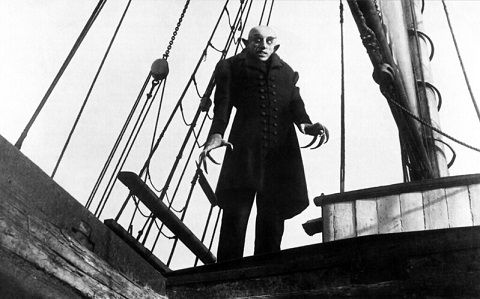
Hutter (Gustav von Wangenheim) is an estate agent in this German town which is hoping to attract a better class of clientele, so when his boss, Knock (Alexander Granach) gives him the good news that one such client has contacted him, and he is a wealthy baron from the Carpathians named Orlok (Max Schreck), they are both beside themselves with joy. Finally, a break! But back at home, Hutter's wife Ellen (Greta Schroder) senses all may not be well, and not simply because the region the Baron hails from is notorious for its thieves and spectres. Could it be that Hutter and Knock have invited evil here?
The story of Nosferatu's survival is a well-known one, and all thanks to director F.W. Murnau's flagrant flouting of the copyright laws. It had been based on Bram Stoker's already-classic novel Dracula, and though Stoker was long gone when this was released, his widow was not and clamped down on the efforts here, stopping distribution and demanding all prints be destroyed. However, a handful survived, vampire-like. The issues of ripping off an iconic text but making something culturally indelible are all wrapped up here, though to be frank, how many times down history has nicking an existing work resulted in a happy accident as seismically influential as this was?
So much in the modern vampire lore was invented here, or at least set in stone, that it was only really the lack of a stake through the heart to fend off Orlok that was missing, everything else had, perhaps ironically, been copied as a classic set of rules by vampire horror down the years to this day. Naturally, this makes the experience of watching Nosferatu now a very familiar one, since even if you were only aware of the vampire fiction contemporary to you, you would have a pretty good idea of what was in store from the 1922 effort. Sunlight proving deadly to the bloodsuckers? That started here. The longing for love in Bram Stoker's Dracula or Twilight? Started here too.
More sinister, the fear of the outsider, the foreigner, was made more concrete in Murnau, to the extent that some commentators regard it as an antisemitic item, or at least playing with the Jewish stereotypes that would soon fuel the resurgence in German nationalism after the Second World War. That's certainly an uncomfortable observation, but more than that, the then-recent plague across the globe of Spanish Flu, which killed millions, without anyone pinning down its origins to any great satisfaction appears to have been the motivating force behind Murnau's chills. What does Orlok bring with him to the German town, when he eventually arrives? His own brand of the Black Death, carried by his wave of pet rats.
They key to overcoming this alien threat is the reason the villain hangs around: the power of women. Ellen personifies this as someone worth dying for if it means spending time with her, both for Hutter and Orlok, and some commentators have viewed the whole film as a tale of her sexual liberation, even an emancipation once she acknowledges the spell she casts over the most evil of entities, and the improvements she makes to the lives of the male heroes. She is more or less the only female character in the film of any significance, but so idolised that she has a lot to live up to - which she does. But finally, it is our repulsion for Orlok that makes him such a memorable monster, as Schreck's makeup crafts the first classic horror movie villain. Some would say Conrad Veidt in The Cabinet of Dr Caligari owns that title, but that was an art film, and Nosferatu aims to strike a popular nerve and get under the skin as it does.
[In celebration of the centenary, Nosferatu will be returning to cinemas in the UK & Ireland throughout 2022. Screenings will be announced via the official site. Click here to visit the site.]