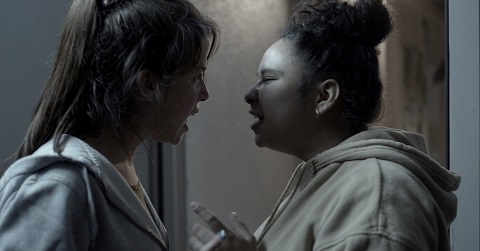
Lora (Claudia Grob) is a Swiss social worker whose charges in the home for teenagers she works in have become more of a handful lately. The problems begin for real when one of the girls seduces a fourteen-year-old boy from a different home who was there for a party; this girl, Audrey, has trouble with keeping her sexual impulses in check, and as she is seventeen and there is a three-year age gap between her and the boy, an official inquiry must be held. Unfortunately for Lora, in her attempts to stick up for Audrey, she ends up putting her foot in her mouth and making it sound as if the whole home is in a bad way. But actually, that may be true, as the staff are beginning to struggle as much as the residents...
Not exactly the most reassuring depiction of the care system, especially hailing from an actual social worker like the writer and director here, Fred Baillif, who drew on his own experiences to try and depict the complex relationships that emerge from such an establishment as a matter of course. Whether all these crises would indeed occur over the space of a few days was difficult to believe, though not impossible as misery loves company and these girls have the ability to make each other very miserable should that be what they wish to do, but the results did smack a little of dramatic convenience, especially when lead character Lora's personal issues came to a head amidst the morass of arguments and destructive behaviour.
And that was just here. The impression was that Baillif had been immensely frustrated by his time in that job, and now he was a filmmaker he was keen to get out those frustrations in a melodrama that veered all over the place in its focus, which was broken up into chapters, concentrating on a number of characters in turn. That said, of course their stories overlapped as they were in such close proximity, which led to the story going over the same ground more than once in any given situation, which would have been fine had there been any great revelations involved. Yet while you could believe there were girls like these in every care home across the world, that familiarity with the premise did it no favours, as you were mainly awaiting some terrible emotional disaster to befall one or all of them by the end of the film.
You would not be disappointed in that respect, though you may not be able to spot the fulcrum of the disaster, largely since it was down to a number of elements. Baillif's sympathies were never in doubt, however, he was very even-handed with the characters and despite some bad behaviour, or thoughtless behaviour at best, you could tell he was sorry the residents had ever ended up here. Some had been sexually abused by family members, some were buckling under the weight of mental illness, their own and others close to them, violence was in the pasts of a number of the girls, it was the material of many a fly on the wall documentary and as presented here, there did not appear to be any grand solution to any of this. The best thing we can do is keep talking, was the message, since if you cut off the lines of communication, that leads to understanding being shut down as well, and if these kids are isolated, the odds against them making it to adulthood healthy and happy dwindled to nothing. Food for thought, then, but you wished the director had been more disciplined with the semi-improvisation.
[The award winning LA MIF is released in UK cinemas on 25th February 2022.]